¡Aguas! A Warning for US-Mexico Water Sharing (Volume 21, Issue 2)
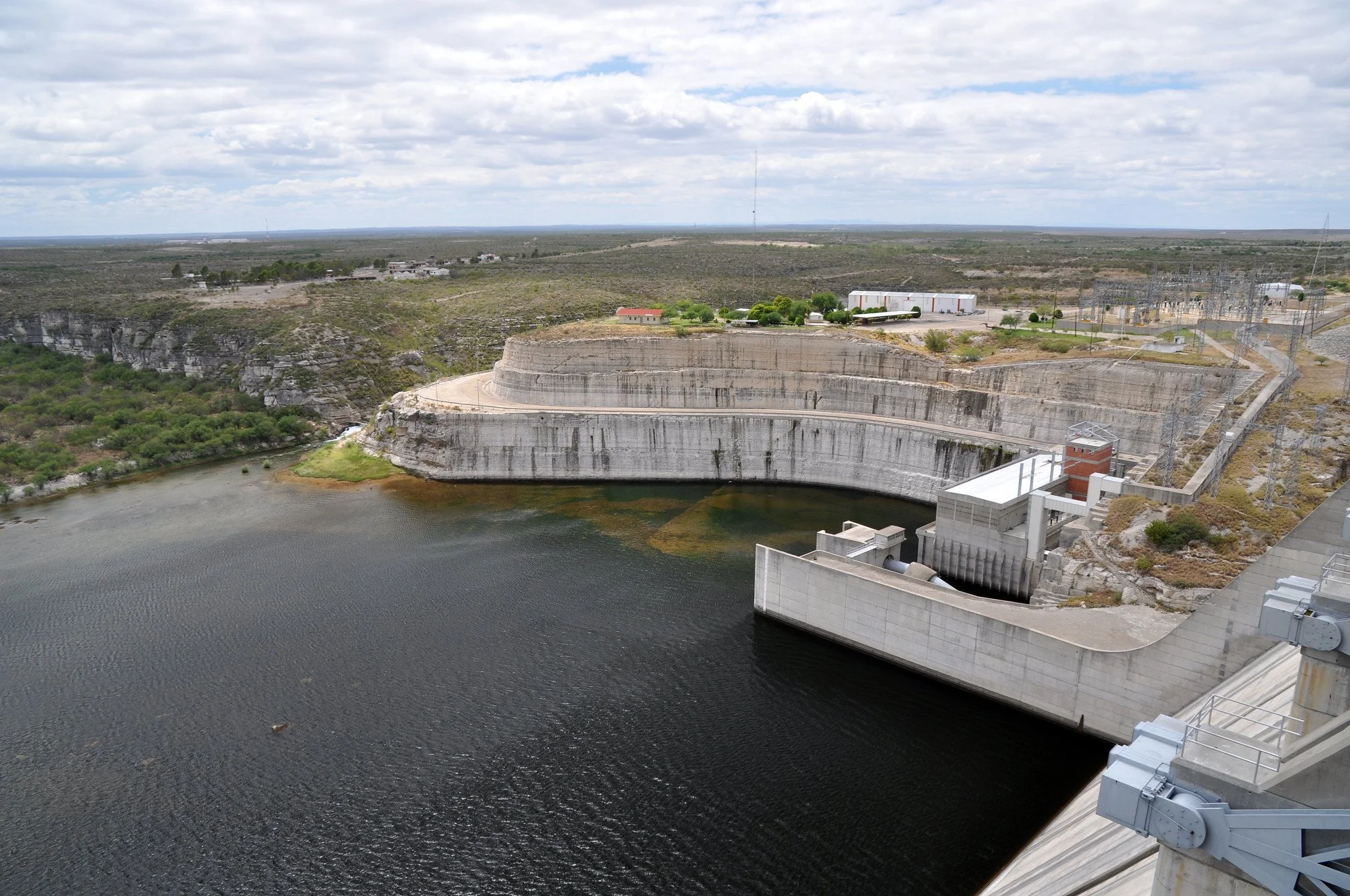
Amistad Dam on the Rio Grande. Source: Creative Commons, Jonathan McIntosh
By Alexandra Helfgott
In colloquial Mexican Spanish, the word for water in its plural form, “aguas,” means “be careful.” It is a phrase of warning – one that is fitting for the current status of U.S.-Mexico water sharing. Since 1944, the United States and Mexico have legally shared water resources. Spanning fourteen presidential administrations in the United States and ten in Mexico, bilateral water sharing has persisted for nearly a century, despite political partisanship, economic challenges, and changing geopolitical dynamics. [1] However, recent challenges have put the nearly century-old agreement under duress.
Water sharing between the two countries is measured in five-year cycles. When the most recent water sharing cycle concluded in October 2025, Mexico had delivered just 50.6 percent of the total water it owed to the United States. [2] The water sharing agreement still stands, but Mexico’s recent shortfall has put the agreement under intensified scrutiny by the Trump administration and Texas lawmakers. Seeking to sidestep the diplomatic negotiation process that has governed bilateral water sharing for the past eighty years, they have sought to forcibly impose accountability mechanisms to ensure Mexico’s compliance. These efforts, however, fail to address the fundamental causes that underlie the discrepancies in water supply and demand. Moreover, they sideline experts and sidestep traditional procedure, leading to significant questions about the future of bilateral water sharing.
A combination of changing water flows—the result of climate change—and increased industrial demand for water have exacerbated the mismatch between water supply and water demand, prompting frustration on both sides of the border. Whereas the United States delivers water to Mexico annually, Mexico’s water delivery requirements are measured according to five-year cycles. As such, Mexico tends to deliver water in the final year of the cycle, rather than evenly spacing water deliveries throughout the five-year water period. This is a major point of contention for U.S. stakeholders, especially Texas farmers, who have argued that the irregular water deliveries complicate crop planting. Mexico can expect regular water deliveries from its northern neighbor, but the United States cannot say the same of Mexico.
A key point of contention in bilateral water sharing involves the lack of congruency, specifically in terms of reduced water deliveries. For example, the terms of the water sharing agreement permit the United States to reduce its water deliveries, with no obligation for the United States to repay the reduced amount. Between 1939 and 2015, the United States invoked this exemption in approximately 30 percent of those years. [3] However, for Mexico, no such exemption exists. Mexico must repay its water debt during the following five-year cycle – regardless of drought conditions that would otherwise grant the United States the ability to reduce water deliveries. Whereas in the United States water demand is primarily for commercial purposes, in Mexico, water is for both commercial and residential use. As such, water shortages have an outsized impact on the 11 million domestic consumers residing in Mexico’s border states, as compared to their American counterparts across the border who primarily rely on Mexico’s water for commercial purposes. [4]
New geopolitical dynamics have also accelerated and ignited further controversy regarding bilateral water sharing. For the first time since the agreement’s signing in 1944, the United States rejected Mexico’s request for additional water in the spring of 2025, citing Mexico’s delinquency in water payments in past water cycles – though Mexico has consistently repaid its water debts in subsequent water cycles. [5] On the Mexican side of the border, water sharing disputes have also intensified. In September 2020, two civilians were killed when the Mexican National Guard clashed with farmers in the state of Chihuahua, protesting the government’s decision to utilize reservoir water to comply with the treaty. [6]
The treaty’s original signatories had the prescience to designate experts, not elected officials, to supervise treaty implementation, lead its enforcement, and inform subsequent negotiations. [7] They created the International Boundary and Water Commission (IBWC), a binational body comprised of subject matter experts knowledgeable about water flows, water use, and, perhaps most importantly, water sharing. Overseen by the U.S. State Department and Mexican Secretariat of Foreign Affairs, the IBWC supervises treaty compliance and manages disputes by creating “minutes” – legally enforceable amendments to the treaty – a role clearly delineated in the 1944 water sharing agreement.
For decades, the IBWC operated with meaningful independence. However, this precedent ended in 2020 after President Trump, and subsequently, Mexican President Andrés Manuel López Obrador (AMLO), became increasingly involved in water sharing negotiations. In 2025, Trump’s public commentary only further escalated the debate. The president praised Ted Cruz’s efforts to secure water for Texan farmers, accused Mexico of “stealing water”, and blamed his predecessor for “refus[ing] to lift a finger to help.” [8] The president’s commentary has empowered both local elected officials and the U.S. Department of Agriculture (USDA) to take charge of the issue of water sharing, rejecting traditional protocol established by the IBWC.
Instead of permitting the IBWC to address the points of friction through the traditional minute process, the USDA and U.S. State Department, alongside Mexico’s Secretariat of Foreign Affairs, have led recent discussions. In February 2026, the United States and Mexican governments announced a new agreement to enhance bilateral water sharing. [9] Mexico agreed to deliver a minimum of 350,000 AF of water during the current five-year cycle and develop a plan to repay its water deficit. To ensure timely water deliveries, both countries will participate in monthly meetings to assess water levels. This agreement echoes the language already present in the 1944 Treaty, which suggests, but does not mandate, that Mexico deliver an average of 350,000 AF of water per year. Because this agreement was not negotiated through the formal minute process, it will be difficult to enforce legally. However, it offers a political victory, allowing the USDA and others to claim progress for Texas farmers without meaningfully advancing negotiations.
The ongoing controversy in U.S.-Mexico water sharing is a cautionary tale, one in which the government prioritizes political expediency over practical expertise. While resolution of the current water sharing debate should be celebrated, it should also be viewed with caution: political officials, not experts, negotiated this outcome, abandoning traditional protocol of the 1944 Treaty that designated the IBWC as the primary negotiating body. We should return to the political tradition in which diplomats and area experts – whether on the topic of trade or water – inform, guide, and lead negotiations. Elected leaders should not unilaterally drive changes to the treaty but rather empower experts and policymakers to do what they do best: develop evidence-based policies that incorporate short-term needs with long-term outlooks.
The water sharing agreement has shortcomings, but its enduring nature is proof that diplomacy works best when it is based on a foundation of trust, rather than coerced with threats. U.S.-Mexico water sharing highlights that policy agreements must be treated like living documents – rooted in the era in which they were written but revised to reflect current realities. As the challenges of the 21st century grow increasingly complex, the legislative frameworks utilized to address, mitigate, and simply live with these issues must grow in tandem. For example, restructuring delivery timelines and addressing the drought exemption asymmetry could be addressed to ensure timely, reliable, and equitable water deliveries from both countries. But above all, U.S.-Mexico water sharing is a signal, an alarm in the face of the increasing encroachment of the executive branch and other elected officials, at the expense of subject matter experts and their institutional knowledge.
Aguas, be careful.
About the author
Alexandra Helfgott is a Staff Editor at the Yale Journal of International Affairs and Master in Public Policy candidate at the Yale Jackson School. She is interested in the U.S.-Mexico relationship, particularly the impact of Mexico’s domestic politics on bilateral relations, and previously worked at the Wilson Center where she researched and wrote about global supply chains and energy in North America.
Endnotes
[1] While there are technically two separate legislative agreements that govern water sharing, most analyses, including this one, only focus on the 1944 Treaty. All references made to the water sharing agreement in this piece refer to both the 1944 Treaty and the 1906 Convention.
[2] International Boundary and Water Commission United States and Mexico, “Weekly 5 Year Cycle Status (Mexico Deliveries) – IBWC,” 2025, accessed October 24, 2025, https://www.ibwc.gov/water-data/mexico-deliveries/.
[3] Congress.gov, "U.S.-Mexican Water Sharing: Background and Recent Developments," January 31, 2026, https://www.congress.gov/crs-product/R43312.
[4] Southern Border Communities Coalition, “The U.S.-Mexico Border Region at a Glance - Border Lens: A Border Research Project,” June 28, 2023, https://www.southernborder.org/border_lens_southern_border_region_at_a_glance.
[5] Guardian Staff and Agencies, “US Rejects Mexico’s Request for Water as Trump Opens New Battle Front,” The Guardian, March 20, 2025, www.theguardian.com/us-news/2025/mar/20/tijuana-mexico-water-trump.
[6] Jose Luis Gonzalez, “Two Killed as Violence Spills from Mexico Protest against Water Flow to US,” Reuters, September 10, 2020, https://www.reuters.com/world/two-killed-violence-spills-mexico-protest-against-water-flow-us-2020-09-09/.
[7] Office of U.S. Sen. Ted Cruz, “Sen. Cruz Introduces Legislation to Hold Mexico Accountable for Lack of Water Deliveries to Texas,” November 7, 2025, www.cruz.senate.gov/newsroom/press-releases/sen-cruz-introduces-legislation-to-hold-mexico-accountable-for-lack-of-water-deliveries-to-texas.
[8] Donald J. Trump Posts from Truth Social, @TrumpDailyPosts, “Mexico OWES Texas 1.3 million acre-feet of water under the 1944 Water Treaty, but Mexico is unfortunately violating their Treaty obligation. This is very unfair,” April 10, 2025, https://x.com/TrumpDailyPosts/status/1910468411546567122.
[9] U.S. Department of Agriculture, “Statement by Secretary of State Marco Rubio and Secretary of Agriculture Brooke Rollins,” February 3, 2026, https://www.usda.gov/about-usda/news/press-releases/2026/02/03/statement-secretary-state-marco-rubio-and-secretary-agriculture-brooke-rollins.
Disclaimer
The views expressed in this paper are solely those of the author and do not reflect the opinions of the editors or the journal.