Czechia’s Missed Dual-Use Pivot (Volume 21, Issue 2)
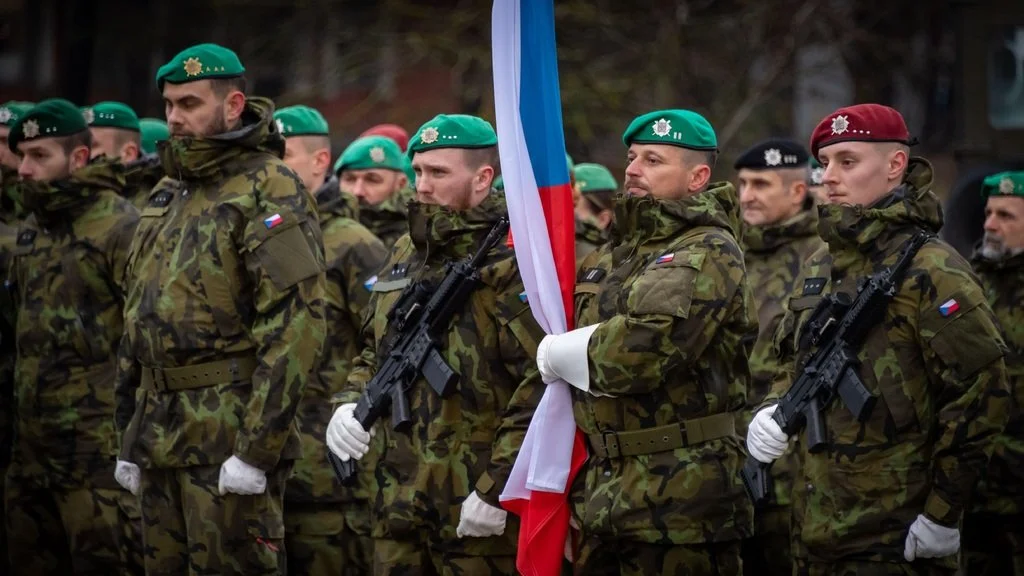
Czech armed forces' deployed in Latvia displaying their rank insignia on the battle dress uniform. Source: Creative Commons, Cech.Adam
By Jonas Nepozitek
Prague is squandering a generational opportunity to transform its industrial base and achieve greater levels of security and competitiveness. While the last government finally agreed to increased levels of defense spending, its successor is bringing it significantly below the required 2 percent of GDP, insisting that it is enough to sustain the country’s security. [1] For a small and exposed nation like Czechia, it certainly is not. Poland, in comparison, has reached 4.5 per cent of GDP in defense spending in 2025, whilst also becoming a European economic tiger. [2] As the country faces a prolonged conflict almost right on its doorstep, worsening Transatlantic relations, and a faltering industry that is still heavily tied to the slowing German market, the situation demands a strategic response—not fiscal minimalism. The war is unfolding much closer to Prague than its current approach to security would suggest, presenting strategic risks that are ignored by the current administration in spite of the Kremlin's frequent hybrid operations across Eastern Europe. Despite these risks, the government's response has been shaped more by domestic political considerations.
The motivations for cutting defense spending are, from a certain perspective, understandable. Many Czech citizens are still dissatisfied with their economic well-being, and fear that more guns will lead to less butter, such as lower availability of housing. [3] Putting that money into systemic reforms or growth-oriented projects could certainly be a viable alternative. However, that is not the path the new government chose. Instead, it has opted for short-term social spending and unnecessary tax cuts that do little to support long-term growth and that are aimed at self-employed persons—who are already significantly advantaged compared to other social strata in Czechia—thus missing an opportunity to strengthen the nation’s resilience and shift the traditional discourse around defense spending. [4]
A polycrisis can be a blessing in disguise. Across Europe, geopolitical tensions have driven increased interest among investors in the defense sector, with even private equity groups getting in on the game. [5] What was once almost seen as a shameful vehicle for capital appreciation is now a valid way of utilizing assets whilst contributing to regional security. Concurrently, political support for defense investments in the EU has increased both in Brussels and among the major European players. The recent $150bn Security Action for Europe (SAFE) program that provides “competitively priced, long-maturity loans to Member States requesting financial assistance for investments in defence capabilities” speaks for itself. [6] The institutions are listening, and the markets are responding. Usually, it’s one or the other.
In light of this, Prague had a unique chance to shift the country’s traditional conception of defense spending from consumption to investment: to utilize defense spending in pursuit of security and economic growth through a much-needed industrial revival. When managed well, higher defense spending allocated to R&D and dual-use tech can guarantee returns that exceed the initial inputs. Recent papers suggest that markets tend to reward dual-use R&D by recognizing potential both in peace and war. [7] This can be achieved by crowding in relevant players and creating clusters of knowledge that produce spillover effects. [8] Successful examples can be found in the US DARPA model or in the Israeli conscription-based innovation ecosystem, which produces dual-use human capital that performs both on the battlefield and in the private sector. [9] The real question lies not necessarily in whether to invest 2, 3, or 4 per cent of GDP on defense, but what those billions can accomplish in terms of security, diplomacy, and industrial performance. Even better—what can they achieve, accounting for the nation’s unique central geographic position and comparative advantages that stem from its extensive manufacturing and high-tech expertise? The German Volkswagen has recently begun talks with an Israeli state-owned defense firm, Rafael, to produce components for the Iron Dome due to the faltering automotive industry. [10] Perhaps, Czechia could take inspiration.
Regrettably, the government chose a different path. The Ministry of Finance cut defense spending by over $1bn and refused to challenge the public debate that constantly revolves around salaries, equipment, and F-35s (as if fighter jets were the most meaningful output in defense). [11] Since at least the Draghi report on EU competitiveness, which proposed concrete solutions to Europe’s major structural economic shortcomings, Europeans have floated a vision of a European DARPA as a centralized dual-use innovation center. [12] Czechia does not need its own DARPA, but it does need to utilize its existing tools and participate fully in the European initiatives. Czechia’s NATO-DIANA accelerator hub is but a first step toward the commercialization of dual-use technologies. However, long-term military-civil fusion will need to be preceded by full political support that ensures both growth and security. [13]
Although not fatal, the government’s recent steps signal an unwillingness to participate in wider European and NATO efforts toward a more competitive and secure continent. This has serious security implications, as Czechia willingly decreases its ability to face kinetic and non-kinetic threats in a prolonged or hybrid conflict—something that might soon become a reality for the wider Eastern Europe. Czechia’s actions might also repel the very investors who are already turning toward European defense, decrease the viability of long-term defense-industrial projects, and diminish the nation’s credibility at the negotiating table. Trump, for instance, has made it clear that 2 per cent is not enough anymore, and that NATO members who fail to step up might not be protected by the alliance’s strongest member. [14] For over 40 years, Czechia fought for sovereignty from the Soviet satellite control. Defending that sovereignty comes with a price.
The recently proposed “two-speed” Europe project suggests that those who fail to move forward will be left behind. [15] In a world where defense spending demands are already shifting upwards, Czechia risks being caught off guard as the floor rises if its sole focus remains on the minimum spending requirements. Without a clear strategy, Prague will chase numbers instead of tangible industrial and military outcomes, risking the nation’s security and growth potential. Instead of taking the lead, Czechia might become a liability.
About the author
Jonas Nepozitek is a Staff Editor at the Yale Journal of International Affairs and Master in Public Policy candidate at the Yale Jackson School. He comes to Yale with a background in the Czech civil service.
Endnotes
[1] ČTK, “Vláda nebude v rozpočtu navyšovat výdaje na obranu, řekl Okamura”, Seznam Zprávy, 26 January 2026, https://www.seznamzpravy.cz/clanek/domaci-politika-vlada-nebude-v-rozpoctu-navysovat-vydaje-na-obranu-rekl-okamura-297334.
[2] Karol Luczka, “The political chess behind Poland’s military spending”, The Kyiv Independent, 27 March 2026, https://kyivindependent.com/the-political-chess-behind-polands-military-spending/; The Economist, “How Poland can keep its place at the heart of Europe”, 22 May 2025, https://www.economist.com/leaders/2025/05/22/how-poland-can-keep-its-place-at-the-heart-of-europe.
[3] SOCDEM, “Bydlení je naše zbrojení. SOCDEM představila řešení bytové krize”, https://socdem.cz/akt-aktuality/bydleni-je-nase-zbrojeni-socdem-predstavila-reseni-bytove-krize/.
[4] ČTK, “Sociální odvody živnostníků zřejmě nevzrostou, Sněmovna to podpořila”, Seznam Zprávy, 16 January 2026, https://www.seznamzpravy.cz/clanek/domaci-politika-socialni-odvody-zivnostniku-zrejme-nevzrostou-snemovna-to-podporila-296432’ Jakub Svoboda and Martin Procházka, “Nově si ze státního rozpočtu polepší doprava a sociální věci, méně dostane obrana”, Novinky.cz, 26 January 2026, https://www.novinky.cz/clanek/ekonomika-nove-si-ze-statniho-rozpoctu-polepsi-doprava-a-socialni-veci-mene-dostane-obrana-40559583; Petr Vilím et al., “Rovnější zdanění OSVČ”, PAQ Research, p. 38, https://www.paqresearch.cz/content/files/2025/07/PAQ_OSVC_Studie-3.pdf.
[5] Lindsey Berckman et al., “2026 Aerospace and Defense Industry Outlook”, Deloitte Research Center for Energy & Industrials, 13 November 2025,
https://www.deloitte.com/us/en/insights/industry/aerospace-defense/aerospace-and-defense-industry-outlook.html; Fraser Clark and Ieva Miyares, “Private capital in European defence: from peripheral sector to strategic imperative”, Deloitte, 11 November 2025,
[6] Council Regulation (EU) 2025/1106 of 27 May 2025 Establishing the Security Action for Europe (SAFE) through the Reinforcement of the European Defence Industry Instrument (Text with EEA Relevance) (2025), http://data.europa.eu/eli/reg/2025/1106/oj.http://data.europa.eu/eli/reg/2025/1106/oj; European Commission, “SAFE | Security Action for Europe”, https://defence-industry-space.ec.europa.eu/eu-defence-industry/safe-security-action-europe_en.
[7] Fabrizio Ferriani et al., “Beyond Military Sales: The Market Premium on Dual-Use R&D in the Defence Sector,” SSRN Scholarly Paper no. 5763571 (Social Science Research Network, November 18, 2025), https://doi.org/10.2139/ssrn.5763571.
[8] Ethan Ilzetzki, “Guns and Growth: The Economic Consequences of Defense Buildups”, Kiel Institute for the World Economy, 2 February 2025, https://www.kielinstitut.de/fileadmin/Dateiverwaltung/IfW-Publications/fis-import/7afb0d80-68d0-49ae-8cae-1decc74fd972-Kiel_Report_Ethan.pdf.
[9] Senor, Dan, and Saul Singer. Start-up nation: The story of Israel's economic miracle. McClelland & Stewart, 2011.
[10] Linus Höller, “Volkswagen in talks to make Iron Dome parts at struggling German auto plant: report”, DefenseNews, March 26, 2026, https://www.defensenews.com/global/europe/2026/03/26/volkswagen-in-talks-to-make-iron-dome-parts-at-struggling-german-auto-plant-report/.
[11] “‚Leopardíky‘ a F-35 jsou drahé, hájí Ševčík škrty ve výdajích na obranu. Činčila: Jde o bezpečí lidí,” iROZHLAS, February 11, 2026, https://www.irozhlas.cz/ekonomika/leopardiky-a-f-35-jsou-drahe-haji-sevcik-skrty-ve-vydajich-na-obranu-cincila-jde_2602111358_elev.
[12] European Commission, ed., The Future of European Competitiveness: Part A: A Competitiveness Strategy for Europe (Publications Office, 2025), https://doi.org/10.2872/1823372.
[13] Czechinvest, “Defence Hub,” accessed February 11, 2026, https://czechinvest.gov.cz/en/Key-sectors/defence-hub.
[14] Alys Davies and Nathan Williams, “Trump Says Nato Defence Spend Rising to 5% of GDP Is ‘big Win’ for US and the West,” BBC News, accessed February 11, 2026, https://www.bbc.com/news/live/cm2ld0e0rzkt; Stephen Fowler, “Trump says he wouldn't defend NATO allies from Russia if they're 'delinquent'”, NPR, accessed March 30, 2026, https://www.npr.org/2024/02/11/1230658309/trump-would-encourage-russia-to-attack-nato-allies-who-dont-pay-bills.
[15] Christian Kraemer et al., “Germany Pushes for ‘two-Speed’ Europe with New Bloc of Six Leading Economies,” China, Reuters, January 27, 2026, https://www.reuters.com/world/china/german-french-ministers-aim-boost-eu-competitiveness-with-new-format-2026-01-27/.
Disclaimer
The views expressed in this paper are solely those of the author and do not reflect the opinions of the editors or the journal.