How the WHO Can Improve Its 2025 Amendment: The Global Pandemic Patent Fund (Volume 21, Issue 2)
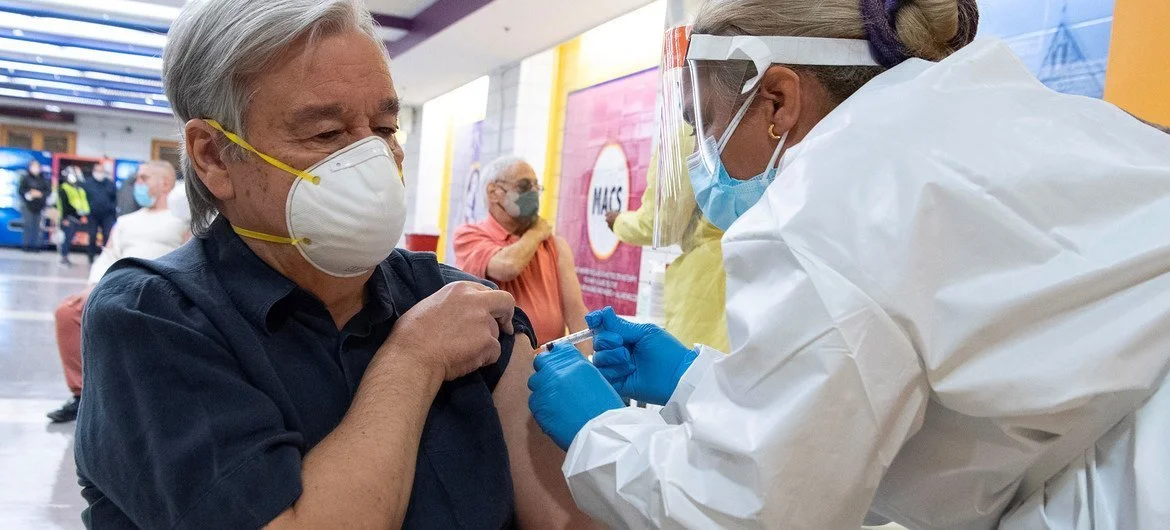
UN Secretary-General António Guterres receiving the COVID-19 vaccine. Source: UN Photo
By Yeonsu Kim and Jay Shim
Introduction: The WHO’s 2025 Amendments
When the world was paralyzed with COVID-19, the World Health Organization (WHO) failed to achieve the three key benchmarks of its strategy to achieve global COVID-19 vaccination by mid-2022: 10 percent of the global population by September 2021, 40 percent by December 2021, and 70 percent by mid-June 2022. [1]
The WHO’s failure to meet these targets exposed profound inequalities in global vaccine distribution. [2] According to the United Nations Development Programme (UNDP), only 12 percent of the population in low-income countries had been vaccinated by mid-2022, compared to 73 percent in high-income countries. [3] The human cost of this disparity was devastating; mathematical models estimate that if equitable distribution had met the WHO’s 40 percent coverage target by the end of 2021, nearly 600,000 additional lives could have been saved worldwide. [4] This demonstrates that vaccine nationalism was a primary blocker of the global effort to overcome COVID-19.
In an effort to rectify such vaccine inequity, the WHO has amended its pandemic governance framework three times, in 2022, 2024, and 2025. [5] Most notably, the 2025 revision introduced four new components: Article 12, the Pathogen Access and Benefit-Sharing System; Article 13, the Global Supply Chain and Logistics Network; Article 11, the transfer of technology; and Article 18, sustainable financing. [6]
These amendments demonstrate good intentions but remain limited by their reliance on voluntary mechanisms, failing to provide the economic incentives necessary to overcome the intellectual property barriers that fuel vaccine nationalism. To bridge this gap, this paper proposes the Global Pandemic Patent Fund (GPPF), a new structure that would rectify these market failures. Following an analysis of the amendments' limitations, the paper details the GPPF framework using Gavi and the Medicines Patent Pool (MPP) as precedents, and proposes a "hub-and-spoke" model to ensure equitable global vaccine production.
Evaluation of the 2025 WHO pandemic agreement
The 2025 WHO Pandemic Agreement presents a monumental advance from a voluntary donation system from developed countries—which could be criticized as charity—to a structured framework aimed at amending the systematic failures of the COVID-19 era. By establishing Articles 11, 12, 13 and 18, the agreement acknowledges that global health security can only be sustained when equity is structurally addressed. [7] Since allowing regional disease reservoirs increases the risk of pandemics, tackling health inequality must be a cornerstone of global health strategy.
On the positive side, the establishment of the Pathogen Access and Benefit Sharing System under Article 12 is a significant step forward as it moves beyond voluntary genetic data by linking data-sharing to the guaranteed equitable distribution of health products. This addresses the previous systemic gap, where pathogen data was often shared without a comprehensive and binding benefit sharing mechanism legally mandating obligations for participating manufacturers during pandemic emergencies. In addition, Article 11 emphasizes transferring technology and Article 13 provides a vital framework to diversify manufacturing capacities through the Global Supply Chain and Logistics Network, especially in the global south. These provisions suggest a move toward a “One Health” framework, where solidarity is not just a moral interest but an institutionalized principle. [8]
However, a closer examination reveals that the agreement faces substantial restrictions to its implementation. The primary impediment lies in its linguistic flexibility and lack of market-compatible enforcement. Throughout Article 11, the instruction for technology transfer is equipped by the phrase “as mutually agreed,” which grants intellectual property holders a veto power over the process. [9] While the agreement acknowledges trade-related aspects of intellectual property rights flexibility, it fails to establish a mechanism that could override the private pharmaceutical profit incentives during an emergency.
Moreover, the financial architecture under Article 18 remains unreliable. While it suggests “sustainable and predictable financing,” implementation still relies on voluntary contributions according to the availability of member states. This is a concern that needs to be addressed given that the World Bank estimated an international financing gap of at least $10.5 billion per year for pandemic preparedness, which the voluntary nature of the agreement is unlikely to solve. [10] Therefore, this system weakens long-term financing and aid, leaving the world insufficiently prepared for future pandemics. Furthermore, this failure to guarantee large-scale capital mobilization risks the international community’s ability to secure timely access to patents without prolonged legal or financial conflicts and to initiate production quickly enough.
In summary, while the 2025 amendments provide an important normative framework, the tension between intellectual property protection and equitable access remains unsolved. To fill this gap, the international community must move beyond aspirational guidelines and create a concrete and pre-funded mechanism that can operate as a true international public good within the global market needs. The lack of such a mechanism will deepen the geopolitical health divide and harm international trust, while also leaving remaining disease reservoirs in underdeveloped regions to generate more variants and a threat of other potential emergencies. This necessitates a practical policy shift to the GPPF.
Policy Solutions: The Global Pandemic Patent Fund
The GPPF is a policy mechanism designed to offer equitable access to vaccines for all member states of the WHO during global pandemics by purchasing vaccine patents through a globally pooled fund.
Mechanism of the GPPF
Once the GPPF is established, the WHO member states would collectively contribute to establish an exclusive pandemic joint fund in advance, thereby creating a large-scale financial pool that no single country could afford independently. When a pandemic emerges and a pharmaceutical company successfully develops a new vaccine, the WHO would use the joint fund to purchase the vaccine’s patent rights. The acquired patent would then be shared and designated as an international public good, enabling all member states to access and utilize the vaccine simultaneously.
To ensure operational efficiency without creating redundant bureaucracy, the GPPF would utilize existing WHO governance structures. The fund would officially be activated when the WHO Director-General declares a public health emergency of international concern under the International Health Regulations. Once triggered, the decision of which patent to purchase would then be guided by the WHO’s established Strategic Advisory Group of Experts on Immunization (SAGE) in conjunction with its prequalification program, which would ensure that medical products meet global standards for quality, safety, and efficacy. Ultimately, the scale of this guaranteed financial pool would act as a powerful market incentive, driving pharmaceutical companies to compete for the buyout and aligning private sector innovation with global public health needs.
For equitable participation, the fund would adopt a progressive and tiered contribution system by imposing different levels of financial burden on developed and developing states. The classification of the tiers would be based on gross national income (GNI) per capita in purchasing power parity (PPP) as calculated by the World Bank Group; this measure is considered one of the most equitable measures of national wealth. Under this framework, countries would be divided into three tiers. Tier 1 would bear the largest share of financial responsibility, contributing approximately 70–80 percent of the total fund. Tier 2 would contribute a moderate share proportional to their economic capacity. Lastly, Tier 3 would be either exempt or required to provide only a symbolic contribution.
Although this arrangement may appear burdensome to high-income countries, the disparity in economic capacity among member states justifies such differentiation. For example, Norway, which recorded the third highest GNI per capita (PPP) in 2023 among WHO member states, possesses an income level more than one hundred times greater than that of Burundi, the country with the lowest GNI per capita (PPP) among the WHO member states. [11] Accordingly, this structure would reflect the principle of tax fairness—commonly referred to as the “capacity to pay” principle—and would extend it to the realm of global governance.
Empirical Precedents: The Gavi and the MPP
The GPPF may still appear to be an unrealistic experiment; however, it would represent a practical attempt to integrate two proven mechanisms that have been successfully applied in the global health sector. The two core components of the GPPF—pre-financing and patent sharing—have each demonstrated their effectiveness in addressing different diseases around the world.
Gavi Advance Market Commitment: Pre-funding
In the early 2000s, a vaccine for pneumococcal disease was developed, but its high cost prevented widespread distribution in low-income countries. The disease killed about 826,000 children aged 1–59 months in 2000. [12] To address this challenge, Gavi—an international organization dedicated to improving access to new and underused vaccines for children in the world’s poorest countries—established the Advance Market Commitment (AMC) fund. [13] Through the AMC, Gavi raised approximately 1.5 billion U.S. dollars from multiple donor countries to subsidize vaccine purchases for developing nations.
By transforming uncertain market demand into guaranteed revenue, the AMC encouraged major pharmaceutical companies, including Pfizer and GSK, to participate in vaccine production for low-income countries through guaranteed procurement contracts. As a result, more than 60 countries gained access to pneumococcal vaccines, and it is estimated that over 700,000 child deaths were prevented. [14] This case demonstrates that collective pre-financing can effectively incentivize firms to willingly supply essential medicines and address market failures.
Medicines Patent Pool: Patent Sharing
During the early stages of the HIV/AIDS crisis, the annual cost of treatment reached approximately $13,000 per patient. [15] Strict intellectual property protections allowed pharmaceutical companies to maintain exclusive pricing, making HIV/AIDS a death sentence in many African countries.
In this context, global pressure and mediation by the MPP—a United Nations–supported public health organization—enabled an alternative patent-sharing distribution model. [16] Under this arrangement, patent holders voluntarily transferred their patents to the MPP, which subsequently issued sublicenses to multiple pharmaceutical firms at lower prices. The resulting increase in market competition significantly reduced treatment costs. As a result, the annual cost of HIV/AIDS treatment fell to approximately $100, and more than 90 percent of patients in low- and middle-income countries gained access to treatment. [17] Building on this experience, the GPPF would include strategic patent buyouts with fair compensation, ensuring firm participation through guaranteed incentives.
However, these two mechanisms, while effective in specific contexts, are insufficient in isolation to address a pandemic of global magnitude. While pre-funding guarantees vaccine purchases, it does not secure the underlying patents to break production monopolies. Conversely, while patent-sharing provides the framework for wide distribution, it lacks the financial capital to buy out the intellectual property rights of expensive vaccines. Therefore, the GPPF would synthesize these proven mechanisms—the financial predictability of Gavi’s AMC and the legal efficiency of the MPP—into a single, pre-funded institutional framework. By doing so, it would create a self-sustaining mechanism that transforms pandemic response from a reactive humanitarian effort into a dynamic market-based solution.
Hub-and-Spoke Vaccine Plants
Patent access and funding alone, however, guarantee neither production capacity nor quality control. Without specialized facilities and raw materials, intellectual property remains a dormant asset. To address this challenge, the GPPF could employ a hub-and-spoke model that would empower technologically advanced countries—such as South Africa, Indonesia, Saudi Arabia, and Egypt—to serve as regional vaccine hubs. These candidate countries possess national regulatory authorities (NRAs) designated as WHO Maturity Level 3 (ML3) or 4 (ML4), ensuring that their medical products adhere to international standards for safety, efficacy, and quality. [18] An NRA maturity level of 3 or higher indicates that medical products released for public distribution, including vaccines and diagnostic tools, undergo thorough evaluation and meet international standards for efficacy, safety, and quality. [19]
By designating these high-capacity states as hubs, the GPPF would enable acquired patents to be practically utilized to provide vaccines for neighboring ‘spoke’ countries, thereby minimizing logistical hurdles and supporting a rapid spread or provision. To incentivize participation, hub countries would receive additional financial support from the GPPF. Thus, the hub countries would gain not only health finance strengthening but also the opportunity to become a crucial health strategic point in the circumstance of global health issues, while at the same time improving their national status and trust. Therefore, this structure would transform pandemic responses from a reactive effort into a resilient and decentralized solution, offering comprehensive opportunities for as many regions as possible.
The implementation of the GPPF would be expected to reshape the global health system. By minimizing vaccine production and distribution barriers through pre-funded buyouts, the fund would guarantee equitable access and incentivize rapid innovation among pharmaceutical companies. Furthermore, the establishment of regional hubs would enable a decentralized and resilient manufacturing framework, empowering the global south to grow their own health sovereignty. Beyond health, this framework would address critical economic vulnerabilities as well. During the COVID-19 crisis, centralized vaccine distribution left developing nations at the mercy of global supply chains and exchange rate fluctuations when importing expensive doses. By enabling decentralized production, the GPPF would stabilize regional economies, preventing cascading economic collapses and safeguarding national infrastructures worldwide. Ultimately, this proactive investment system would create strong benefits as the relatively small cost of maintaining the fund would help avoid the far greater loss caused by uncontrolled outbreaks.
Conclusion & implications
The COVID-19 pandemic showed that national health security is fundamentally intertwined with global health security. While the 2025 WHO Pandemic Agreement establishes important normative standards, it relies on ‘mutually agreed’ terms and voluntary contributions, leaving the global community vulnerable. [20] The GPPF would bridge this gap by aligning public health needs with market-based incentives. By synthesizing pre-funding with strategic patent buyouts and regional hub-and-spoke production, the GPPF would transform vaccines from exclusive commodities into accessible international public goods.
Still, implementing the GPPF would be challenging. Success depends on the complex legal harmonization between the fund and national patent offices, as well as the establishment of precise assessment methods for patent buyouts to make fair compensation possible. Nevertheless, as former U.N. Deputy Secretary-General Amina Mohammed once said, “No one will ever be truly safe until everyone is safe.” [21] Therefore, the WHO should adopt a system that can shift from reactive and voluntary charity to structural preparedness. To fulfill this necessity, this paper proposes the GPPF that would work as a necessary insurance policy, protecting global health security in an interdependent era.
About the author
Yeonsu Kim is an undergraduate researcher majoring in international relations at Ewha Womans University. Her research interests include international organizations, global health governance, and policy mechanisms for addressing global inequality.
Jay Shim is an undergraduate researcher studying International Studies at Ewha Womans University. Her research interests include international cooperation in making inclusive and collective society. She aspires to contribute to dismantling structural inequalities within global health and housing sectors to foster a more resilient and equitable international community.
Endnotes
[1] World Health Organization, “Strategy to Achieve Global Covid-19 Vaccination by mid-2022,” 2021.
[2] Kaamil Ahmed, “Covid vaccine figures lay bare global inequality as global target missed,” The Guardian, July 21, 2022, https://www.theguardian.com/global-development/2022/jul/21/covid-vaccine-figures-lay-bare-global-inequality-as-global-target-missed.
[3] United Nations Development Programme (UNDP), “Global Dashboard for Vaccine Equity,” accessed December 15, 2025, https://data.undp.org/vaccine-equity/.
[4] Oliver J. Watson, Gregory Barnsley, Jasmine Toor, Alexandra B. Hogan, Peter Winskill, and Azra C. Ghani, “Global impact of the first year of COVID-19 vaccination: a mathematical modelling study,” The Lancet Infectious Diseases 22, no. 9, 2022, pp. 1293-1302, https://doi.org/10.1016/S1473-3099(22)00320-6.
[5] World Health Organization, “WHO Pandemic Agreement,” WHA Res. 78.1 (May 20, 2025), pp. 1. The preamble of this resolution explicitly recalls the amendments to the International Health Regulations (2005) adopted in 2022 (WHA75.12) and 2024 (WHA77.17).
[6] World Health Organization, “WHO Pandemic Agreement,” arts. 11–13, 18.
[7] Ibid., arts. 11-13, 18.
[8] World Health Organization, “One Health,” World Health Organization, accessed January 22, 2026, https://www.who.int/health-topics/one-health#tab=tab_1.
[9] World Health Organization, “WHO Pandemic Agreement,” art. 11.
[10] World Health Organization and World Bank, “Analysis of Pandemic Preparedness and Response (PPR) Architecture, Financing Needs, Gaps and Mechanisms, Prepared for the G20 Joint Finance & Health Task Force,” March 22, 2022.
[11] World Bank, “GNI per capita, PPP (current international $),” World Development Indicators, accessed December 16, 2025, https://data.worldbank.org/indicator/NY.GNP.PCAP.PP.CD.
[12] Katherine L. O'Brien, Lara J. Wolfson, James P. Watt, et al., “Burden of disease caused by Streptococcus pneumoniae in children younger than 5 years: global estimates,” The Lancet 374, no. 9693, 2009, pp. 893-902, https://doi.org/10.1016/S0140-6736(09)61204-6.
[13] Gavi, the Vaccine Alliance, “About the Pneumococcal AMC,” accessed December 15, 2025, https://www.gavi.org/investing-gavi/innovative-financing/pneumococcal-advance-market-commitment-amc/about-pneumococcal.
[14] Gavi, the Vaccine Alliance, “The Pneumococcal AMC.”
[15] UNICEF, “Pneumonia Vaccine Price Drops Dramatically for Lower-Income Countries Thanks to the Gavi Pneumococcal Advance Market Commitment,” accessed December 13, 2025, https://www.unicef.org/press-releases/pneumonia-vaccine-price-drops-dramatically-lower-income-countries-thanks-gavi.
[16] Medicines Patent Pool, “Impact – MPP,” accessed December 15, 2025, https://medicinespatentpool.org/progress-achievements/impact.
[17] Medicines Patent Pool and ViiV Healthcare, “Transformative Partnership Enables Widespread Access to HIV Treatment,” accessed December 15, 2025, https://medicinespatentpool.org/news-publications-post/transformative-partnership-between-the-medicines-patent-pool-and-viiv-healthcare-enables-24-million-people-in-low-and-middle-income-countries-to-access-innovative-hiv-treatment.
[18] World Health Organization, “List of National Regulatory Authorities (NRAs) operating at maturity level 3 (ML3) and maturity level 4 (ML4),” April 9, 2026, list-of-nras-operating-at-ml3-and-ml4.pdf.
[19] World Health Organization, “WHO Global Benchmarking Tool (GBT) for evaluation of national regulatory systems,” accessed January 22, 2026, https://www.who.int/tools/global-benchmarking-tools.
[20] World Health Organization, “WHO Pandemic Agreement,” art. 4 and passim.
[21] United Nations, “No One Is Safe Until Everyone Is,” United Nations Department of Economic and Social Affairs, August 3, 2020, https://www.un.org/en/desa/%E2%80%9Cno-one-safe-until-everyone-%E2%80%9D.
Disclaimer
The views expressed in this paper are solely those of the author and do not reflect the opinions of the editors or the journal.