
By Laura Edwards
Laura Edwards of the University of Pennsylvania draws attention to the rise in investment treaty claims involving protestors, and developments to codify the right to protest in international human rights law.
Read MoreBy Laura Edwards
Laura Edwards of the University of Pennsylvania draws attention to the rise in investment treaty claims involving protestors, and developments to codify the right to protest in international human rights law.
Read MoreBy Sophie Zinser and Dr. Hannah Thinyane
Integrating leaps in technology into the existing multilateral initiatives, local legal policies, and social movements against human trafficking will be the most effective way to address the problem at scale.
Read MoreBy Paul Lendway
Using a national survey experiment consisting of rural white Republicans – a group that tends to oppose expanding redistributive programs – this study shows that informational and empathy-enhancing interventions are effective at increasing support for expanding Medicaid and Medicare benefits in the United States.
Read MoreBy Jacob Kurien and Bernard Yudkin Geoxavier
What steps should China take to successfully promote RMB internationalization? Jacob Kurien and Bernard Yudkin Geoxavier provide updated recommendations.
Read MoreBy Charles Smythe
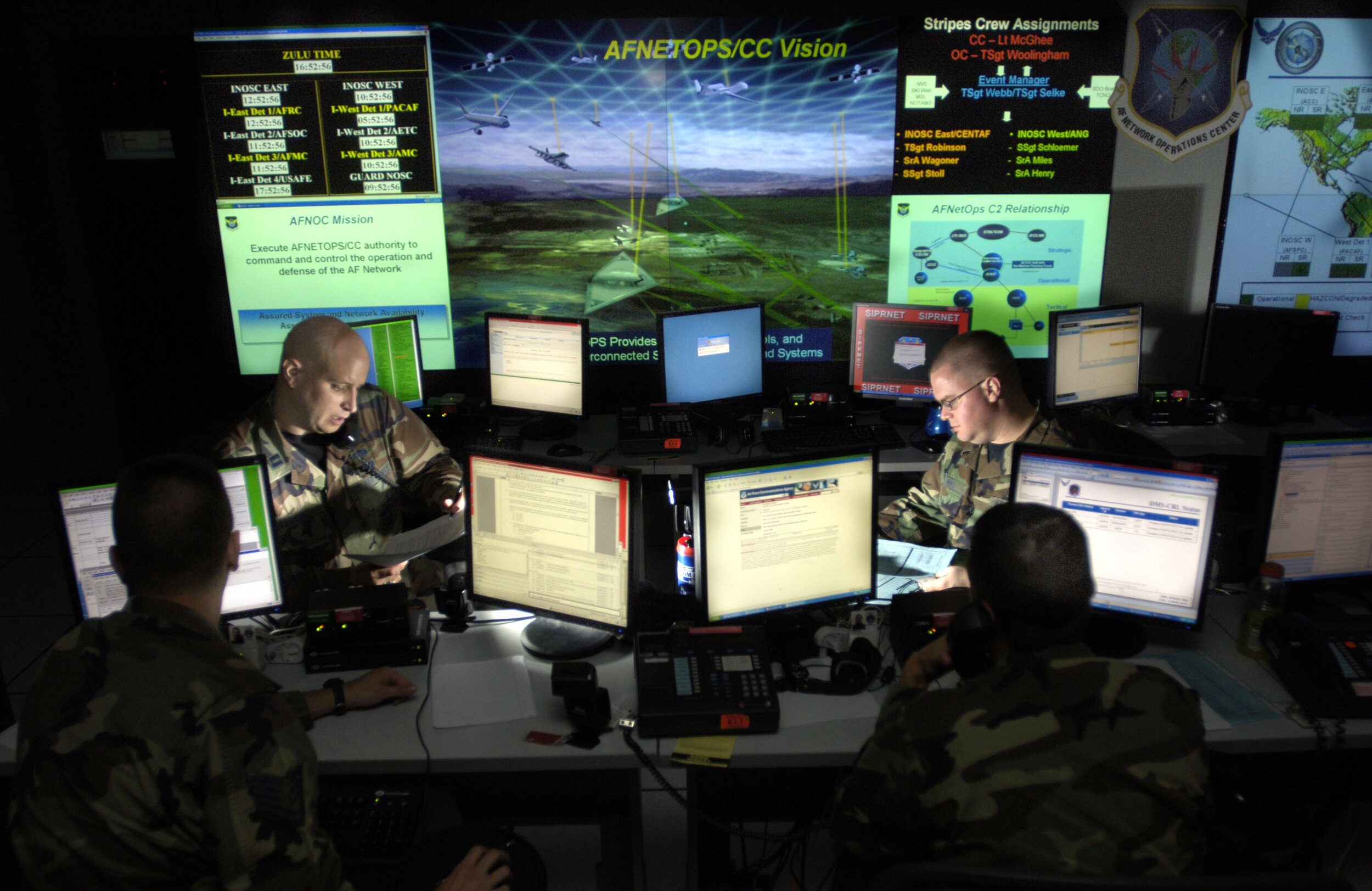
A growing consensus among U.S. military leadership and policy makers is that offensive strategies have an advantage over defensive strategies in cyberspace. However, this consensus is based on a series of misperceptions.
Read MoreBy Aaron Baum
This paper recommends that ASEAN countries create investment screening mechanisms close to OECD recommendations and that ASEAN itself encourages working- and Ministerial-level engagement on investment screening via a new Sectoral Ministerial Body that will track regional investment trends.
Read MoreBy Ryan Nabil
In the long term, as the gap between Russian and Chinese economic and military capabilities widens, the basis of Russia-China relations—trade, security cooperation, and stability in the post-Soviet space—are likely to weaken. Moscow’s management of the changing Russia-China relations will shape Russia’s future relations with China and the West.
Read MoreBy Tony Formica
Extremist groups have been on the rise for the past four years, and an uptick in extremist-related violence has followed in their wake.2 Prominent social media platforms have been tacitly implicated in these attacks, facilitating extremist recruitment, disseminating propaganda, and spreading disinformation.
Read MoreBy Julian TszKin Chan and Weifeng Zhong
Can we predict governments’ policy moves through changes in propaganda messages? Julian Chan and Weifeng Zhong take a machine learning approach to predict China’s stance on key political issues.
Read MoreBy Joe Kyle
As the preeminent institution for maintaining European security, the North Atlantic Treaty Organization (NATO) must address the growing sphere of Russian influence in non-NATO member states.
Read MoreBy Erik Woodward
The low-lying atoll nations of the South Pacific Ocean are sinking. An interpretation of international law suggests that a deterritorialized state could be a legally permissible international entity.
Read MoreBy Meg King & Jake Rosen
In a process rife with uncertainty and at times high with tension, the United States, Canada, and Mexico managed to reach terms for a broad new trade arrangement to replace NAFTA.
Read MoreBy Nicolai N. Petro
Religious conflict in Ukraine has been much in the news of late, ever since President Petro Poroshenko very publicly embraced the ambitious idea of creating a single, unified Orthodox Christian church out of the country’s many Orthodox denominations. This idea, long dear to the hearts of Ukrainian nationalists, kept the issue on the front pages of the media in Ukraine, Russia, and other predominantly Orthodox countries for most of 2018.
Read MoreBy Loren Voss
There is a startling similarity across the globe in the language politicians and media organizations use to describe people fleeing for their lives. In response to a growing number of desperate and displaced people, the rhetoric coming from governments and newspapers is largely the same—these “others” threaten our beloved nation—letting them in would destroy its very foundation.
Read MoreBy Sir Roderic Lyne
As Putin enters his next six-year stretch (which will be punctuated, mid-term, by Duma elections in 2021), two related questions will arise. First, can Putin – a man who trusts few people — develop a successor from the next generation who is strong enough to control Russia’s baronies, and whom he can trust to protect him, his family, his associates, and their vast wealth? Second, what will Putin seek to achieve in possibly his last term in office?
Read MoreBy Aiden Warren and Alek Hillas
That landscape of war and how it is conducted is changing exponentially. For the first time in history, humankind is confronted with the prospect that autonomous robots may join the battlefield.
Read MoreBy Zeinab Khalil
The project of gender mainstreaming has gained much clout in global affairs, and particularly in women in development (WID) networks. This article analyzes gender mainstreaming, which was configured by European feminist policymakers and liberal developmentalist discourses, through the lens of postcolonial theory and feminist political economy.
Read MoreBy Behbod Negahban
Analysts commonly depict Iran’s Supreme Leader, Ali Khamenei, as the prime mover behind the Islamic Republic’s foreign policy. This paper will challenge this view, arguing that the IRGC both pressures and enables the Supreme Leader to adopt hard-line policies through its influence on three aspects of the regime.
Read MoreBy Nicki Softness
Historical analysis of Russia’s strategic military choices suggests that the state would prioritize the United States’ information technology (IT) and communications critical infrastructure as key cyber targets. In reaction to such an attack, the United States would have to choose from a spectrum of military and intelligence counter-responses, ranging from lower-level alternatives, to those with high potential for escalation.
Read MoreBy Doaa Abdel-Motaal
Antarctica has been a commercial and political battleground ever since its discovery, with silent competition for its resources still in full swing. If not carefully managed, the “Question of Antarctica,” as the United Nations has called it, could once again burst onto the international stage. Antarctica’s political and environmental future hangs in balance.
Read More