Assurances Are Not Guarantees: Budapest's Lesson for Nonproliferation (Volume 21, Issue 2)
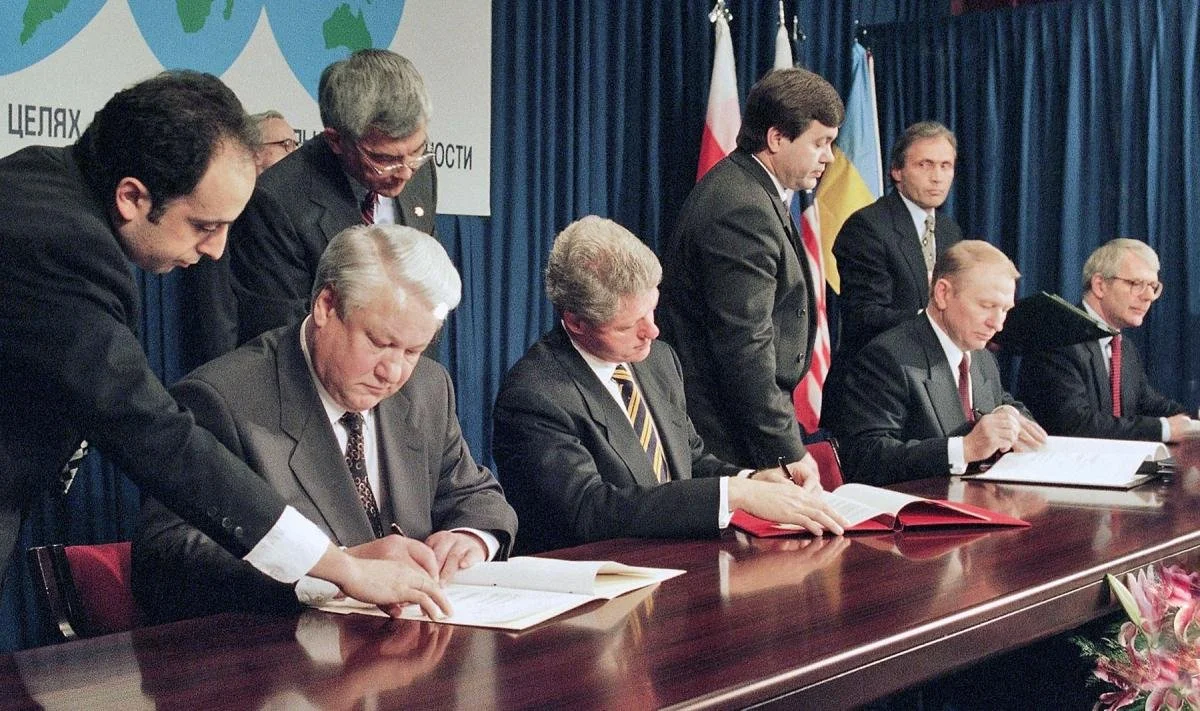
Boris Yeltsin, Bill Clinton, Ukrainian President Leonid Kuchma, and British Prime Minister John Major sign the Budapest Memorandum on December 5, 1994. Source: Brookings Institution
By Alexei Hoffman
Introduction
The Budapest Memorandum of 1994 facilitated the largest voluntary denuclearization in history, and its collapse should end the use of security assurances as a nonproliferation instrument. Ukraine dominates virtually every discussion of the memorandum, and understandably so: it is the signatory whose territorial integrity has been most dramatically violated. Yet Ukraine was one of three non-Russian states that struck the identical bargain on December 5, 1994. When the Soviet Union collapsed, its three nuclear-armed successor states, other than Russia—Ukraine, Belarus, and Kazakhstan—possessed more nuclear weapons on their territory than France, the United Kingdom, and China combined. Ukraine inherited approximately 1,900 strategic warheads atop 176 intercontinental ballistic missiles, making it the world's third-largest nuclear arsenal. Kazakhstan held some 1,410 warheads, including 104 SS-18 missiles, the heaviest ICBMs in the Soviet inventory, ranking it fourth globally. Belarus controlled 81 road-mobile SS-25 ICBMs. In total, these three states surrendered over 3,200 strategic nuclear warheads in what remains the largest voluntary denuclearization in history. [1]
All three states—Ukraine, Belarus, and Kazakhstan—received the same security assurances from the same three guarantors: the United States, the United Kingdom, and Russia, in exchange for acceding to the Non-Proliferation Treaty and transferring their warheads to Moscow. Yet, as the Defence Horizon Journal observes, "there seems to be a lack of discourse on whether Belarus or Kazakhstan should have kept the weapons that were on their territory." [2] Post-2014 scholarship focuses almost exclusively on Ukraine, with Belarus and Kazakhstan appearing only as brief historical context before analysis turns elsewhere.
Examining the divergent trajectories of all three signatories shows that the Budapest model failed not because of Russian duplicity alone, but because security assurances without enforcement mechanisms cannot provide protection regardless of how recipient states respond afterward.
Assurances vs. Guarantees
The Budapest Memorandum's weakness was not an accident of implementation; it was a feature of design. U.S. negotiators deliberately chose the term "security assurances" over "security guarantees"—a distinction that sounds technical but carried existential consequences. In diplomatic parlance, an assurance specifies what the guarantor will not do: it will not violate territorial integrity, it will not threaten force, it will not coerce economically. A guarantee implies what the guarantor will do: it will defend, it will intervene, it will act. [3] NATO's Article 5 is a guarantee. The Budapest Memorandum offered something categorically weaker.
The trilingual text embedded this distinction through deliberate imprecision. The English version promised “security assurances,” but the equally authentic Russian and Ukrainian texts used “гарантии” and “гарантії” – words that translate directly and exclusively as “guarantees.” [4][5]
This was not a translation error. In January 1994, during negotiations over the predecessor Trilateral Statement, U.S. officials read a statement into the formal record clarifying that whenever 'guarantee' appeared in the Russian or Ukrainian versions, the term carried the lesser sense of the English word 'assurance.' Steven Pifer, who led the U.S. negotiating team, later put the matter bluntly: the term "assurances" was chosen because "we were not prepared to extend a military commitment." [6] The 82nd Airborne was not coming to defend Crimea, and Kyiv understood this.
Critics understood the implications at the time. John Mearsheimer's 1993 Foreign Affairs article warned that "Ukraine cannot defend itself against a nuclear-armed Russia with conventional weapons, and no state, including the United States, is going to extend to it a meaningful security guarantee." [7] He specifically predicted disputes over the Black Sea Fleet and control of Crimea.
The memorandum defined what signatories would refrain from doing; it did not define what anyone would do if those commitments were broken. When violation came, first in 2014, then comprehensively in 2022, Budapest provided no mechanism for remedy and imposed no obligation to act.
Ukraine: When the Guarantor Attacks
Russia's annexation of Crimea in March 2014 violated the Budapest Memorandum's core commitments, Articles 1 and 2, which bound signatories to respect Ukraine's territorial integrity and refrain from the use of force. The full-scale invasion of February 2022 extinguished any remaining pretense that the framework retained meaning. Every substantive commitment had been violated by one of its guarantors.
Ukraine's official response evolved from attempted activation to outright repudiation. Five days before the 2022 invasion, President Zelensky announced at the Munich Security Conference that Ukraine would invoke the consultation clause “for the fourth time...but both Ukraine and I are doing this for the last time.” [8] When no consultations materialized and invasion followed, the shift became institutional. The Ukrainian Foreign Ministry's December 2024 statement, issued on the memorandum's thirtieth anniversary, called Budapest “a monument to short-sightedness in strategic security decision-making” and declared, “With the bitter experience of the Budapest Memorandum behind us, we will not accept any alternatives, surrogates or substitutes for Ukraine's full membership in NATO.” [9]
Ukrainian public opinion has undergone a parallel inversion. In 1994, approximately 30 percent of Ukrainians favored retaining nuclear weapons; by December 2024, 73 percent supported their restoration. A November 2024 poll found that nuclear weapons development slightly outpolled NATO membership as Ukrainians' preferred security guarantee—a direct repudiation of the bargain their country had accepted three decades earlier. [10]
Ukraine has since signed twenty-eight bilateral security agreements under the G7 Vilnius framework, but officials characterize these explicitly as supplements, not substitutes. The Lithuania-Ukraine agreement states plainly: 'Any form of bilateral commitments or security guarantees provided to Ukraine by its partners cannot be an alternative to full NATO membership.' The signatories themselves made the conclusion for us." [11]
Belarus: When the Signatory Defects
Belarus was the model signatory. Under Chairman Stanislav Shushkevich, a nuclear physicist who understood all too well what the weapons could do, Belarus completed denuclearization by November 1996—the first of the three to do so. Where Ukraine demanded extensive negotiations, financial compensation, and fuel arrangements, Belarus surrendered its arsenal without preconditions or reservations. The Belarusian Foreign Ministry later emphasized this distinction: the country "voluntarily renounced the possibility of possessing nuclear weapons…without any preconditions or reservations." [12] For twenty-five years, the arrangement held.
Belarus's reversal came in stages. August 2020 brought a contested presidential election and subsequent Western sanctions. In February 2022, Belarus hosted approximately 30,000 Russian troops under the "Allied Resolve 2022" exercises; on February 24, those forces launched the northern front of Russia's invasion from Belarusian territory, crossing through the Chernobyl Exclusion Zone toward Kyiv. Three days later, a constitutional referendum removed the phrase designating Belarus "a nuclear-free zone and a neutral state." By June 2023, Russian tactical nuclear weapons had arrived. [13]
Belarus's officials have explicitly cited Budapest as justification. Defense Minister Viktor Khrenin, signing a nuclear storage agreement with Russia in May 2023, attributed the deployment of Russian tactical nuclear weapons to 'non-fulfillment of the security guarantees given to Belarus in the Budapest Memorandum.' The April 2024 military doctrine codified this reasoning, formally linking nuclear re-hosting to Western guarantors' failure to uphold the memorandum's terms. [14] The outcome is structurally perverse. Minsk surrendered nuclear weapons in exchange for assurances against nuclear threats. Three decades later, it hosts nuclear weapons from one of the original guarantor states, the same guarantor that violated those assurances through military action against another signatory, while attributing the decision to the other guarantors' alleged failures. A Budapest signatory has become the instrument of another signatory's violation. The memorandum contained no safeguards against this possibility: neither against a signatory's domestic transformation nor against its voluntary realignment with the violating guarantor. Belarus demonstrates that the memorandum contained no safeguard against a signatory's voluntary realignment with the violating guarantor—regardless of the domestic process that produced that realignment.
Kazakhstan: When Compliance Buys Nothing
Kazakhstan was not invaded. It did not align with the aggressor. What security does a compliant signatory actually possess when its principal security risk is the guarantor itself? The answer is instructive. Kazakhstan has drawn no actionable security from the Budapest Memorandum. That it pursues survival through diplomatic navigation rather than institutional protection is itself an indictment of the framework.
The clearest window into Kazakhstan's calculus came at the St. Petersburg International Economic Forum on June 17, 2022. President Kassym-Jomart Tokayev, seated directly beside Vladimir Putin, publicly refused to recognize the "quasi-state entities" of Donetsk and Luhansk. [15] The statement was remarkable given the setting, but notably, it stopped short of condemnation. Kazakhstan would not endorse the invasion, but neither would it name Russia as a violator of the memorandum.
Moscow’s response was swift. Within twenty-four hours, Konstantin Zatulin, First Deputy Chairman of the State Duma Committee on CIS Affairs, invoked Kazakhstan's approximately three million ethnic Russians: "If we have friendship, cooperation, and partnership, then no territorial issues are raised. But if that doesn't exist, everything is possible, as in the case of Ukraine." [16]
Kazakhstan maintains what the United States has called its most “well-developed” security partnership in Central Asia, yet its structural position makes any security framework dependent on great-power confrontation functionally unusable. [17] It shares a 7,644-kilometer border with Russia, the world's longest between two countries. Approximately 80 percent of oil exports transit Russian pipelines via the Caspian Pipeline Consortium, which Russia has disrupted multiple times since 2022. These dependencies mean that even a state with demonstrated Western partnership ties cannot translate those ties into the kind of security architecture Budapest was supposed to provide. [18]
In practice, Kazakhstan hedges. Its June 2025 nuclear energy contracts awarded reactor projects to both Russia's Rosatom and China's CNNC simultaneously, institutionalizing multi-vector balancing. The Trans-Caspian International Transport Route, an alternative export corridor bypassing Russia via the Caspian Sea, the South Caucasus, and Turkey, has grown substantially since 2022 but still carries a fraction of what moves through Russian pipelines. [19]
Notably, Kazakhstan has issued no official statement naming Russia as a violator of the Budapest Memorandum, even as it has deepened security ties with the United States through other channels. Whatever drives that silence—strategic caution, economic dependency, geographic reality—the effect is the same: the memorandum plays no role in Kazakhstan's security calculations. As the Center for European Policy Analysis has noted, Kazakhstan's entire hedging approach is premised on Russian restraint—a premise that Ukraine's experience has destroyed. [20]
What the Pattern Shows
The comparative value of examining all three signatories is this: individually, each can be dismissed; Ukraine as Russian revanchism, Belarus as authoritarian capture, Kazakhstan as geographic determinism. Taken together, they cannot. The Budapest Memorandum failed under three distinct stress conditions; the failure is systemic, not circumstantial.
Each case exposes a distinct failure mode. Ukraine demonstrates that assurances provide no protection against determined violation; the framework contained no mechanism to impose costs for breach, and none materialized. Belarus demonstrates that the memorandum's nonproliferation logic can be inverted from within: a signatory state re-nuclearized by hosting the violating guarantor's weapons while citing the framework's failure as justification. Kazakhstan demonstrates that even exemplary compliance generates no security beyond the neighbor's continuing forbearance; the memorandum is operationally irrelevant to Kazakhstan's survival calculus. Three failure modes—violation, subversion, precarity—and no success case to set against them.
The structural inadequacy thesis that emerges from comparative analysis is straightforward: the problem is not Russian bad faith alone, though Russia's violations are unambiguous. The deeper problem is that assurances without enforcement mechanisms cannot deter a determined violator, cannot prevent authoritarian capture from reversing outcomes, and cannot provide security to even model signatories. If the Budapest model failed under three different stress conditions, the model itself is inadequate.
Implications for Nonproliferation
The Budapest Memorandum's collapse is as much a global precedent as it is a regional tragedy. Among states that have pursued nuclear programs in defiance of international pressure, Iran and North Korea have been explicit. As Carnegie Endowment's Ariel Levite observed, these adversaries are now "bound to feel vindicated in their reluctance to contemplate any serious concessions in their nuclear pursuits." [21]
The pattern is consistent. Muammar Gaddafi surrendered Libya's nuclear program in 2003 and was killed by Western-backed forces in 2011. Saddam Hussein's Iraq was invaded after U.N. inspectors verified complete dismantlement. Kim Jong Un developed nuclear weapons and retained sovereignty—declaring in September 2022 that North Korea's nuclear status "has now become irreversible." [22] The inference is not entirely wrong: states that retained nuclear weapons have, so far, retained sovereignty, while those that disarmed have faced invasion, regime change, or structural insecurity. The task for nonproliferation policy is not to argue that this inference is mistaken but to change the conditions that make it rational. So long as denuclearization offers only assurances without enforcement, the calculus will continue to favor nuclear retention.
Proliferation pressure extends beyond adversaries. In South Korea, public support for developing an independent nuclear arsenal now exceeds 70 percent. Japan's former Prime Minister Shinzo Abe raised nuclear sharing arrangements days after Russia's 2022 invasion. Saudi Crown Prince Mohammed bin Salman has vowed that if Iran acquires nuclear weapons, Saudi Arabia will follow "without a doubt." [23] These are states under U.S. extended deterrence whose proliferation debates have accelerated since 2022—not because of Budapest alone, but because Budapest's collapse compounds existing threat perceptions that nuclear retention is the only reliable guarantee.
The policy implications are significant. First, the United States and its allies should retire Budapest-style assurances as a nonproliferation instrument; the model has been discredited, and offering it again will persuade no state that has observed the past decade. Second, future denuclearization agreements, if any, prove negotiable, must include binding treaty commitments with defined enforcement mechanisms; non-binding political assurances, regardless of how many great powers co-sign them, have proven structurally inadequate – the middle ground has collapsed. Third, the United States should adopt a declaratory policy that future nuclear rollback agreements will not be concluded absent Article 5-equivalent security commitments or a defined accession timeline to an existing alliance, and should communicate this standard explicitly to current threshold states so that the terms of any future negotiation are understood in advance rather than improvised under crisis pressure.
These recommendations carry costs. Requiring treaty-level commitments would face severe ratification obstacles in the U.S. Senate, where even modest arms control agreements have stalled for years. A declaratory policy tying denuclearization to alliance-equivalent guarantees would provoke sharp responses from Moscow and Beijing, both of which view NATO expansion as a threat to their security architectures. And Article 5 itself is under strain—European allies are debating whether existing commitments remain credible in a political environment where U.S. treaty fidelity is no longer assumed. These objections, however, do not argue for returning to the Budapest model. They argue for approaching its replacement with clear-eyed realism about the political difficulty involved. None of this makes nonproliferation diplomacy easier. It does make it honest.
About the author
Alexei Hoffman is a U.S. Army veteran and Master of Asian Studies candidate at Georgetown University's Walsh School of Foreign Service, where he is also pursuing the Institute for the Study of Diplomacy's certificate in Diplomatic Studies. A first-generation Russian-American with close family ties to Vladivostok, his research examines security constraints and energy infrastructure across the post-Soviet space. He holds a J.D. from Georgia State University College of Law and is a Young Professionals in Foreign Policy (YPFP) 2026 Rising Expert.
Endnotes
[1] Carnegie Endowment for International Peace and Monterey Institute of International Studies, “Nuclear Successor States of the Soviet Union: Status Report on Nuclear Weapons, Fissile Material, and Export Controls,” no. 5, March 1998, pp. 9-10, 20.
[2] Dermot Nolan, “Ukraine, The Budapest Memorandum And The Question Of Nuclear ‘Inheritance’,” The Defence Horizon Journal, January 2, 2023, https://tdhj.org/blog/post/ukraine-budapest-memorandum-nuclear-inheritance/.
[3] Steven Pifer, remarks in “The Budapest Memorandum at 20: The United States, Ukraine, and Security Assurances,” transcript of a public event, Brookings Institution, December 9, 2014, pp. 4, https://www.brookings.edu/wp-content/uploads/2014/12/20141209_budapest_memorandum_transcript.pdf.
[4] Pronounced approximately 'ga-RAN-tee-ee' (Russian) and 'ha-ran-TEE-yi' (Ukrainian). Both derive from the same root and carry the same unqualified meaning: guarantees. There is almost no chance that a native speaker of either language would read these terms as conveying anything less than a binding commitment.
[5] United Nations, “Memorandum on Security Assurances in Connection with Ukraine’s Accession to the Treaty on the Non-Proliferation of Nuclear Weapons,” United Nations Treaty Series 3007, no. I-52241, pp. 168 (English title), 173 (Russian title: “о гарантиях безопасности”), 177 (Ukrainian title: “про гарантії безпеки”), https://treaties.un.org/doc/Publication/UNTS/Volume%203007/Part/volume-3007-I-52241.pdf.
[6] Pifer, “Budapest Memorandum at 20,” pp. 22-25.
[7] John J. Mearsheimer, “The Case for a Ukrainian Nuclear Deterrent,” Foreign Affairs 72, no. 3, Summer 1993, pp. 50-51, 55.
[8] Volodymyr Zelenskyy, “Speech by the President of Ukraine at the 58th Munich Security Conference,” President of Ukraine, February 19, 2022, https://www.president.gov.ua/en/news/vistup-prezidenta-ukrayini-na-58-j-myunhenskij-konferenciyi-72997.
[9] Ministry of Foreign Affairs of Ukraine, “Statement of the Ministry of Foreign Affairs of Ukraine on the Occasion of the 30th Anniversary of the Signing of the Budapest Memorandum,” December 3, 2024, https://mfa.gov.ua/en/news/zayava-mzs-ukrayini-z-nagodi-30-richchya-z-chasu-pidpisannya-budapeshtskogo-memorandumu.
[10] Ukrainska Pravda, “Two-thirds of Ukrainians support restoring country's nuclear arsenal – Kyiv International Institute of Sociology,” December 23, 2024, https://www.pravda.com.ua/eng/news/2024/12/23/7490348/ (reporting KIIS polling: mid-1994, 30% favored retaining nuclear weapons; KIIS survey, Dec. 2–17, 2024, 73% supported restoration); New Europe Center, “Foreign Policy and Security. Opinions of Ukrainian Society,” December 2024, pp. 2, 5, https://neweurope.org.ua/wp-content/uploads/2024/12/Annual-Opinion-Poll-Results_eng_print.pdf (INFO SAPIENS poll, Nov. 15–27, 2024: “development of nuclear weapons” 31.3% vs. “gradual accession to NATO” 29.3% as best security guarantee).
[11] Ministry of Defence of Ukraine, “Ukraine’s Security Agreements — What They Entail and Which Countries Have Signed Them, Explained by the Ministry of Defence,” November 8, 2025, https://mod.gov.ua/en/news/ukraine-s-security-agreements-what-they-entail-and-which-countries-have-signed-them-explained-by-the-ministry-of-defence; President of Ukraine, “Agreement on Security Cooperation between Ukraine and the Republic of Lithuania,” June 27, 2024, para. 12, https://www.president.gov.ua/en/news/ugoda-pro-spivrobitnictvo-u-sferi-bezpeki-mizh-ukrayinoyu-ta-91809.
[12] Ministry of Foreign Affairs of the Republic of Belarus, “Statement of the Ministry of Foreign Affairs of the Republic of Belarus ‘On the 20th anniversary of nuclear weapons withdrawal by Belarus,’” November 3, 2016, https://geneva.mfa.gov.by/en/embassy/news/d51c92d8a18c94f5.html.
[13] Council of the European Union, “EU Sanctions Against Belarus,” accessed February 3, 2026, https://www.consilium.europa.eu/en/policies/sanctions/restrictive-measures-against-belarus/; “Vast Drills Spotlight Russia’s Grip on Belarus During Standoff with West,” Reuters, February 9, 2022, https://www.reuters.com/world/europe/vast-drills-spotlight-russias-grip-belarus-during-standoff-with-west-2022-02-09/; “Russia Says Its Forces Have Captured Chernobyl Nuclear Plant in Ukraine,” Reuters, February 24, 2022, https://www.reuters.com/world/europe/russia-says-its-forces-have-captured-chernobyl-nuclear-plant-ukraine-2022-02-24/; “Putin Says First Nuclear Warheads Delivered to Belarus, Will Complete by End-2023,” Reuters, June 16, 2023, https://www.reuters.com/world/europe/putin-says-first-nuclear-warheads-delivered-belarus-will-complete-by-end-2023-2023-06-16/.
[14] Belarusian Telegraph Agency (BelTA), “Хренин: размещение нестратегического ядерного оружия в Беларуси — действенный ответ на политику недружественных стран” [Khrenin: Deployment of Non-Strategic Nuclear Weapons in Belarus Is an Effective Response to Unfriendly Countries’ Policies], May 25, 2023, https://belta.by/society/view/hrenin-razmeschenie-nestrategicheskogo-jadernogo-oruzhija-v-belarusi-dejstvennyj-otvet-na-politiku-568443-2023/; All-Belarusian People’s Assembly, “Об утверждении Военной доктрины Республики Беларусь” [On Approval of the Military Doctrine of the Republic of Belarus], Decision no. 6 (April 25, 2024), para. 58 (author’s translation), officially published April 26, 2024, National Legal Internet Portal of the Republic of Belarus, https://pravo.by/document/?guid=12551&p0=P924v0006.
[15] Ministry of Foreign Affairs of the Republic of Kazakhstan, “Kazakhstan’s President Addresses Challenging Issues on International Agenda and Relations with Russia at Saint Petersburg Economic Forum,” Gov.kz, accessed February 3, 2026, https://www.gov.kz/memleket/entities/mfa/press/news/details/390248?lang=en.
[16] Konstantin Zatulin, quoted in “В Госдуме пригрозили Казахстану мерами ‘как с Украиной’” [State Duma threatens Kazakhstan with measures “as with Ukraine”], Govorit Moskva, June 18, 2022, https://govoritmoskva.ru/news/321290/ (author’s translation).
[17] U.S. Central Command, “Statement of General Lloyd J. Austin III on the Posture of U.S. Central Command,” CENTCOM, accessed March 21, 2026, https://www.centcom.mil/ABOUT-US/POSTURE-STATEMENT/POSTURE-STATEMENT-CONTINUED/.
[18] Vladimir Soldatkin and Olesya Astakhova, “Caspian Pipeline Partially Restores Kazakh Oil Loadings in Black Sea,” Reuters, April 9, 2025, https://www.reuters.com/business/energy/caspian-pipeline-consortium-operating-two-three-black-sea-oil-loading-points-2025-04-09/.
[19] Tamara Vaal, “Russia’s Rosatom, China’s CNNC to Lead Consortiums to Build First Nuclear Power Plants in Kazakhstan,” Reuters, June 14, 2025, https://www.reuters.com/business/energy/russias-rosatom-lead-consortium-build-first-nuclear-power-plant-kazakhstan-2025-06-14/; Tamara Vaal and Fyodor Dmitrenko, “Kazakhstan and Turkey Discussed an Increase in Oil Exports Via BTC,” Reuters, July 30, 2025, https://www.reuters.com/business/energy/kazakhstan-turkey-discussed-an-increase-oil-exports-via-btc-2025-07-30/.
[20] Charles J. Sullivan, “Between a Hawk and a Buzzard: Kazakhstan’s Choices on Russia,” Center for European Policy Analysis (CEPA), April 1, 2025, https://cepa.org/article/between-a-hawk-and-a-buzzard-kazakhstans-choices-on-russia/.
[21] Ariel E. Levite, “Why Security Assurances Are Losing Their Clout as a Nuclear Nonproliferation Instrument,” Bulletin of the Atomic Scientists, June 30, 2022, https://thebulletin.org/2022/06/why-security-assurances-are-losing-their-clout-as-a-nuclear-nonproliferation-instrument/.
[22] Korean Central News Agency, “Respected Comrade Kim Jong Un Makes Policy Speech at Seventh Session of the 14th Supreme People’s Assembly of DPRK,” September 9, 2022, archived at KCNA Watch, accessed February 4, 2026, https://kcnawatch.org/newstream/1662790085-260921382/respected-comrade-kim-jong-un-makes-policy-speech-at-seventh-session-of-the-14th-spa-of-dprk/ (English translation).
[23] The Asan Institute for Policy Studies, “South Koreans and Their Neighbors 2025,” April 28, 2025, pp. 6, https://asaninst.org/bbs/board.php?bo_table=s1_6_1_eng&wr_id=24; Arielle Busetto, “‘Reality of World Security’: Shinzo Abe’s Nuclear Sharing Talk Sparks Debate,” Japan Forward, March 2, 2022, https://japan-forward.com/reality-of-world-security-shinzo-abes-nuclear-sharing-talk-sparks-debate/; “Saudi Crown Prince Says Iran’s Ayatollah Khamenei Is ‘Very Much Like Hitler,’” CBS News, March 15, 2018, https://www.cbsnews.com/news/saudi-crown-prince-says-irans-ayatollah-khamenei-is-very-much-like-hitler/.
Disclaimer
The views expressed in this paper are solely those of the author and do not reflect the opinions of the editors or the journal.