Selective Legalism and China’s Ordercraft: How Beijing Mobilizes Law while Resisting Binding Verdicts (Volume 21, Issue 2)
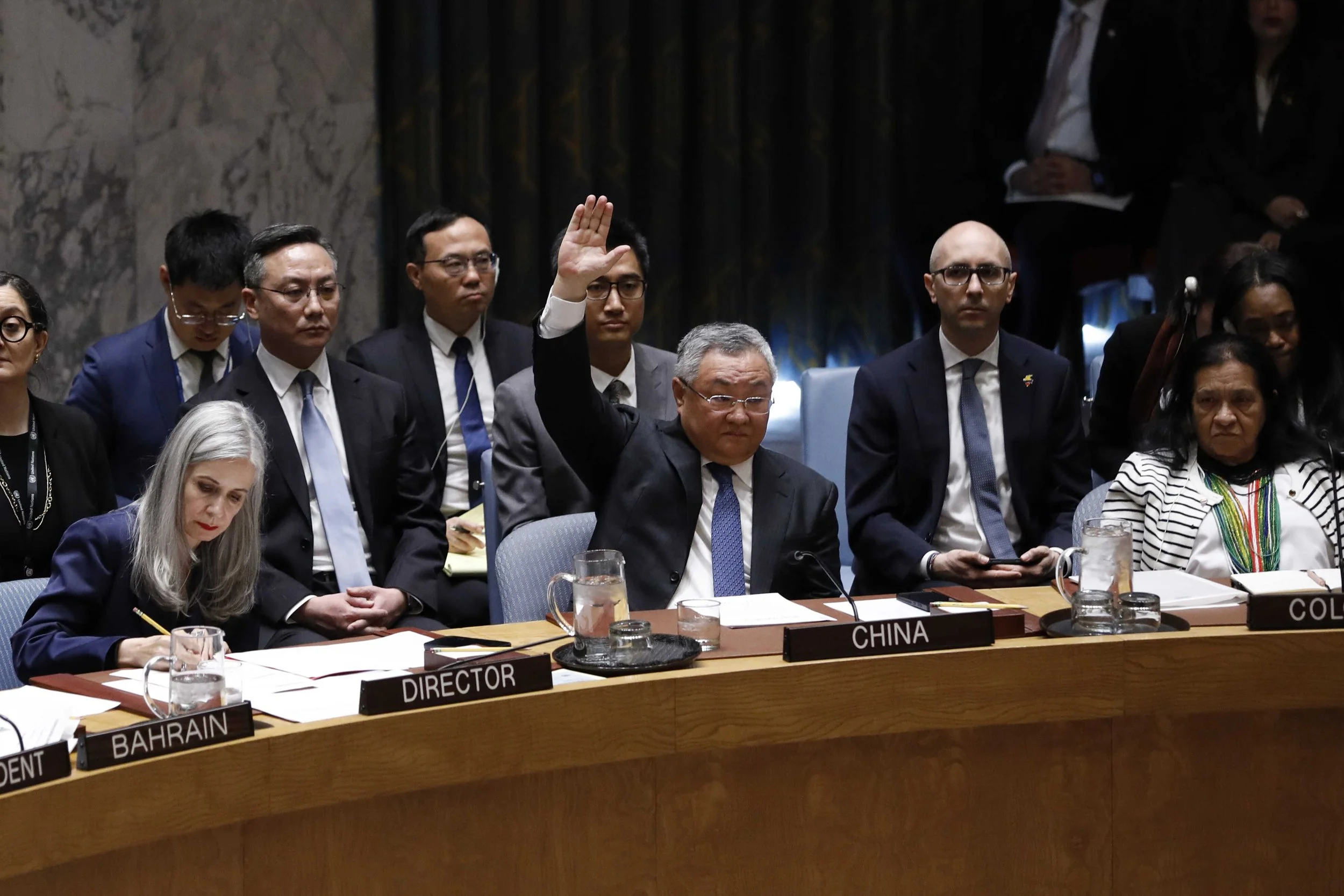
Ambassador Fu Cong on the UN Security Council. Source: Permanent Mission of the People’s Republic of China to the UN
By Stefan Messingschlager
In contemporary diplomacy, “international law” and the “rules-based international order” travel as portable slogans. Yet their political work differs. The phrase “rules-based” can obscure the question that matters most in practice: who gets to say what the rules mean, and what follows when they are breached? China’s recent diplomacy highlights a growing contest not over whether legality exists, but over where legality is produced—in courts, councils, arbitral panels, or bargaining tables. That institutional choice has distributional effects: verdicts can constrain and sometimes equalize, while process-centered bargaining often amplifies power asymmetries. [1]
This article advances a simple claim: China increasingly practices selective legalism. I use the term as shorthand for a recurring pattern: embracing treaty-based rules and legal vocabulary while steering disputes away from venues that can issue binding decisions. The effect is a reallocation of legal authority—from adjudication toward managed negotiation and mediation-centered venue-making. I use ordercraft to denote deliberate efforts to shape the procedural defaults and institutional venues through which legal authority is produced and made consequential. In legal terms, it preserves obligation while restricting delegation. [2]
Selective legalism is neither simple “hypocrisy” nor a wholesale rejection of international law. It is closer to what Robert Williams, a legal scholar at Yale Law School and nonresident senior fellow at the Brookings Institution, calls a flexible and functional approach: law as a tool of legitimation and delegitimation, deployed to shape the context of choice. [3] What is new is how systematically Beijing couples legal vocabulary to procedural engineering.
The argument unfolds through three arenas: Ukraine (2022–present), mediation as institution-building (from the 2023 Saudi–Iran talks to the International Organization for Mediation), and the South China Sea (2016–present). Across them, the pattern is consistent: preserve the grammar of legality, resist verdicts, and steer outcomes toward negotiation. In other words, this ordercraft works less by renouncing rules than by redesigning the procedures and venues through which legal authority is produced and through which consequences become politically and legally thinkable.
At first glance, this may sound like a familiar realist story: great powers ignore constraints and do what they want. Yet the intensity of procedural contestation suggests the opposite—that legal determinations matter even when enforcement is imperfect. Verdicts create authoritative public records, lower the coordination costs of collective response, and narrow the range of plausible legal justifications for inaction. Selective legalism aims to thin this verdict economy—the institutional chain that turns determinations into consequences—keeping law present as vocabulary while making binding determinations rarer and their consequences easier to bargain away.
I. What “Selective Legalism” Is and Is Not
International law’s constraining force is not only normative; it is institutional. A legal rule “bites” when obligation is paired with precision and delegation—especially to third parties empowered to interpret, apply, and publicly articulate what compliance requires. Even without a world government to enforce rulings, authoritative determinations can reshape incentives by shifting reputational burdens and providing focal points for coordination. [4]
The more that authoritative interpretation becomes routinized—through courts, tribunals, and compliance mechanisms—the harder it is for powerful states to treat law as merely rhetorical. Unlike broad political declarations (e.g., many negotiated COP outcomes), adjudicatory verdicts specify whether a rule was breached and who bears responsibility, creating a legal baseline against which responses are judged. To be sure, verdicts do not guarantee compliance—major powers can and do resist adverse rulings—but they still narrow permissible narratives and give others a focal point for coordination and consequence.
Selective legalism exploits a different configuration. It accepts the legitimacy of legal language (obligation as discourse), but strives to reduce delegation to bodies that can issue binding decisions. This is why the strategy cannot be captured by the familiar story of “China violates the rules.” It is better seen as an authority-shifting practice: moving from verdict-producing venues to process-producing venues.
Karen Alter, an international law scholar known for her work on how international law shapes domestic and international politics, shares an account of how international courts gain influence—by “saying what the law means” and by mobilizing supportive audiences that translate rulings into political leverage—that helps clarify what is at stake. Courts rarely coerce compliance on their own; their influence comes from the legal, symbolic, and coordination resources their verdicts provide to states, domestic actors, and coalitions. If law’s authority is partly “made” by institutions and audiences, then weakening the verdict economy—the chain that turns determinations into reputational and material consequences—can be as consequential as violating a norm. [5]
Across the cases examined here, three mechanisms recur in Beijing’s approach. First, forum selection: privileging negotiations, political bodies, or bespoke mediation over adjudication. Second, procedural insulation: invoking sovereignty and consent to keep disputes outside compulsory jurisdiction, including by relying on treaty “safety valves.” Third, venue-making: investing in new institutions that normalize mediation and political settlement as the default mode of legality. Over time, these moves push order toward process without verdict—toward legality anchored in consent and bargaining rather than authoritative determination. [6]
The risk is an order in which “consent” increasingly means bargaining under asymmetry. Weaker states must negotiate over rights that adjudication would otherwise harden into authoritative baselines, while stronger states can more easily convert fait accomplis into “settlements.”
Selective legalism therefore differs from exit strategies. It preserves the legitimacy benefits of membership and compliance talk, while hollowing out the path from rules to rulings. That makes it harder to counter through denunciation alone, because the strategy thrives on partial cooperation and on audiences that value stability over confrontation.
These moves resonate with a wider literature on resistance to international courts. Madsen, Cebulak, and Wiebusch, in a paper titled “Backlash against international courts: explaining the forms and patterns of resistance to international courts,” distinguish ordinary “pushback” from more consequential patterns that aim to reform or constrain courts. [7] China’s approach is distinctive because it combines participation in legal regimes with systematic preference for non-verdict venues—and because it couples that preference with institutional entrepreneurship. The cases below show how lip service to core legal principles can coexist with resistance to the procedural steps that would harden those principles into binding determinations.
II. Ukraine, Since 2022: Charter Rhetoric Without Legal Attribution
China has repeatedly grounded its Ukraine diplomacy in core Charter language—sovereignty, territorial integrity, and opposition to nuclear escalation—while avoiding the legal move that would most clearly allocate responsibility: attributing aggression and its consequences through authoritative procedures. [8] Beijing’s February 2023 position paper, for example, endorses the “purposes and principles” of the U.N. Charter and calls for negotiations, but it does not legally characterize Russia’s invasion in ways that would trigger a clearer verdict logic. [9]
This stance is politically intelligible, and the obvious counterargument is geopolitical: rhetorical hedging to avoid alienating a strategic partner. Yet geopolitics alone cannot explain the pattern. Beijing repeatedly affirms sovereignty and territorial integrity—principles difficult to reconcile with annexation—while declining to translate those principles into legal attribution through authoritative procedures. The same procedural preference appears across issue areas where Russia is not the driver. Selective legalism, in other words, is less about neutrality than about keeping responsibility—and therefore lawful consequences—contestable. To be clear: nothing in this argument depends on treating China as an impartial mediator. The point is that Beijing’s support is structured through procedural choices. By keeping the debate at the level of general principles and “talks,” China can claim Charter guardianship while avoiding the legal moves (such as attribution, remedies, and lawful consequences) that would lock it into a definitive position. For Ukraine, a materially weaker party vis-à-vis Russia, that venue preference risks turning legal entitlements into bargaining chips, dependent on external support rather than on determinate legal baselines.
Yet the question of responsibility matters because it structures what countermeasures appear lawful and legitimate. China’s position paper explicitly opposes “unilateral sanctions” and “long-arm jurisdiction,” underscoring that the argument is waged through legality: it contests not only the conduct at issue, but also the permissibility and jurisdictional basis of responses beyond the Security Council. One can, of course, read this as geopolitical self-interest by a veto holder. But Beijing advances it as a general claim about authorization and extraterritoriality, and it has become a recurring feature of China’s diplomatic legalism across issue areas. In this framing, “talks” are a procedural claim about where enforcement authority should (and should not) reside. [10]
Consistent with this emphasis on process, China has sought to broaden the venue landscape around Ukraine. The 2024 Brazil–China joint proposal for a peace conference recognized by both Russia and Ukraine illustrates this move: it reframes the issue as a process problem on how to restart talks, rather than as a verdict problem on how to uphold specific legal determinations. [11]
Counter-strategies, therefore, should be more legally specific, not less: specify the rule allegedly breached, identify the competent forum, and clarify the legal theory that makes particular countermeasures permissible. Vague appeals to a “rules-based order” can obscure those choices, and they make it easier for process-centered alternatives to present themselves as equally legitimate. [12]
Beijing has also reinforced its “talks-first” posture through coalition signaling. At the U.N. General Assembly in September 2024, China and Brazil co-chaired a “Friends for Peace” group on Ukraine and advanced six “common understandings” aimed at widening support for negotiations. Whatever one thinks of the initiative’s substance, its rhetorical message is clear: China positions itself as an architect of process rather than a sponsor of legal determination. [13]
III. Mediation as Institution-Building: From Saudi–Iran Talks to IOMed
Mediation has clear advantages: it can de-escalate quickly, offers face-saving flexibility, and can unlock settlements when adjudication is politically unreachable. Its weaknesses are equally familiar: opacity, power asymmetry, and the absence of authoritative fact-finding or precedent. For selective legalism, these features can be strategically valuable: mediation can deliver “law-consistent” outcomes without producing a binding legal record that allocates responsibility.
China’s brokerage of the March 2023 Saudi–Iran rapprochement demonstrates how selective legalism can succeed through mediation. The joint trilateral statement framed the outcome as a sovereign decision by the parties, enabled by China’s hosting and sponsorship, and oriented toward reopening embassies and reactivating earlier bilateral agreements. [14]
Mediation is not illegitimate; it is explicitly endorsed in the U.N. Charter’s catalog of peaceful settlement tools. But its authority flows from consent and political buy-in, not from third-party verdicts. In selective legalism’s logic, that is precisely the appeal: mediation can deliver de-escalation and settlement while keeping legality procedural—thin on attribution, thick on process. [15]
That logic becomes institutionally explicit with the creation of the International Organization for Mediation (IOMed). The novelty is not mediation itself, but the attempt to institutionalize it as a standing, intergovernmental venue with its own legitimacy and procedural defaults. In May 2025, thirty-three states, including China, signed the Convention establishing IOMed in Hong Kong, presenting it as a permanent legal organization devoted to mediation in international disputes. [16]
In late 2025, Hong Kong’s Department of Justice announced that the Convention had entered into force for China (including the HKSAR) on August 29, 2025 and gazetted an order giving effect to IOMed’s legal status, privileges, and immunities in Hong Kong. [17] IOMed’s inauguration materials underscore the institution-building ambition and report that eight countries had ratified the Convention by October 2025. [18]
Two points matter for international order. First, IOMed channels a demand—especially among many Global South states—for less adversarial dispute settlement and for procedures perceived as less Western-dominated. Second, shifting the default from adjudication to mediation has distributional effects: mediation is typically confidential, discretionary, and power-sensitive, whereas adjudication creates public legal records that can anchor coalitions and consequences. If mediation becomes the default even for disputes where legal determinations are central (territory, maritime rights, sanctions), smaller states may find it harder to convert legal rights into leverage.
The institutional question, for any state that cares about predictable dispute settlement—including the United States, Europe, and many middle powers—is therefore not whether mediation is good or bad, but how to design transparency, due process, and follow-through so that mediation complements rather than substitutes for binding accountability. For policymakers, the practical implication is to treat IOMed as an emerging venue that may shape defaults over time. Engagement can be conditional and calibrated, but abstention is not cost-free if it leaves procedural standards—and reputational benefits—to others.
IV. The South China Sea, Since 2016: Verdict Rejected, Administration Expanded
The South China Sea is the clearest illustration of selective legalism’s logic: accept the treaty framework, reject the verdict. China is a party to the United Nations Convention on the Law of the Sea (UNCLOS), whose dispute settlement system provides that decisions of competent courts and tribunals are final and binding on the parties. [19] In July 2016, an arbitral tribunal constituted under UNCLOS issued its Award in the Philippines v. China case, rejecting China’s “nine-dash line” claims as incompatible with the Convention and clarifying the status of contested features. [20]
China responded with a categorical statement that the award was “null and void” and had “no binding force,” reiterating that it neither accepted nor recognized the arbitration. [21] This was not an ad hoc improvisation. In August 2006, China deposited a declaration under UNCLOS Article 298, excluding categories of disputes from compulsory procedures entailing binding decisions. [22] As Zou and Ye note in their paper, “Interpretation and Application of Article 298 of the Law of the Sea Convention in Recent Annex VII Arbitrations: An Appraisal,” Article 298 functions as a “safety valve”: it preserves broad adherence to UNCLOS by allowing states to carve out sensitive sovereignty-related disputes. Yet the South China Sea tribunal held that the Philippines’ submissions did not entail maritime delimitation and thus fell outside China’s Article 298 carve-outs. [23]
The post-2016 trajectory shows the other half of the strategy: administrative normalization. Rather than withdrawing from UNCLOS, China has doubled down on coast guard operations, regulatory practices, and infrastructure that treat contested spaces as governed facts. The legal conflict thus becomes a contest between a binding but unenforced award and a daily routine of administration. Without routinized “verdict consequences,” smaller and middle powers must continually relitigate—in diplomatic and public arenas—what was supposed to have been legally settled. This is precisely why verdicts are contested: even when unenforced, they can anchor coalitions and constrain narratives. For smaller claimants such as the Philippines, this means that even a favorable award does not “settle” the dispute; it raises the ongoing costs of contestation and the need for coalition support to translate law into leverage.
A realist might object that none of this changes the balance of power: China controls the sea because it can. But the post-2016 trajectory suggests that law is not irrelevant; it is actively contested. Beijing did not exit UNCLOS, nor did it abandon legal argument. Instead, it invested in delegitimizing the tribunal while deepening administrative practice. That combination only makes sense if authoritative verdicts—even unenforced—carry reputational and coalition costs worth blunting.
Recent developments underscore how venue and narrative remain contested. On January 20, 2026, China said it warned away a Philippine government aircraft over Scarborough Shoal; days later Manila lodged “firm representations,” underscoring that the dispute remains politically live a decade after the award. [24]
V. Implications: A Thinner Verdict Economy in a Multiplex Order
Taken together, these cases show how selective legalism can thrive in a world that is increasingly plural in venues and authority claims. This is not a claim that procedure replaces power; hard power shapes which disputes reach which venues, and whether rulings are enforced. The point is that institutions still structure how power is justified, coordinated, and sometimes constrained. The liberal international order never monopolized legality, but it did embed a growing “verdict economy”: a set of institutions that produce authoritative determinations and create reputational, economic, and political costs for defiance. [25]
Selective legalism weakens that economy in two ways. First, it encourages a migration of disputes toward forums where the endpoint is negotiation rather than judgment. Second, it treats binding decisions as optional inputs into bargaining rather than as determinations that structure bargaining. In that sense, selective legalism is best understood as a toolkit for preserving discretion in a more contested, venue-plural world—not necessarily as a fully formed alternative legal order.
This has distributional consequences. Great powers are often best positioned in bargaining forums, especially where facts on the ground can be created and defended. Adjudication, by contrast, can partially offset asymmetry by creating a public record, clarifying legal baselines, and enabling coalitions to coordinate consequences. If adjudication is delegitimized or bypassed, smaller states lose a key mechanism for converting legal right into political leverage.
The implication is not that international law is collapsing. Rather, legality becomes more procedural and less verdict-centered. Tom Ginsburg’s account of authoritarian international law anticipates a version of this dynamic: international legal rhetoric and rules can be repurposed to reinforce regime survival and sovereign discretion, including through looser cooperation and negotiated settlement. [26]
Venue proliferation is not accidental. As Amitav Acharya argues in an influential account of an emerging “Multiplex World,” global order-building is becoming more pluralistic, multi-agentic, and less centered on any single hegemonic constructor. In such an environment, the question “which institution decides?” becomes a central stake of politics. Different venues privilege different resources: adjudication rewards legal argument, transparency, and the ability to mobilize compliance constituencies; it also narrows issue-linkage. Negotiation and mediation, by contrast, allow confidentiality, side-payments, and cross-issue bargaining—areas where a state with large economic and diplomatic leverage can often do better. Selective legalism exploits this venue structure. [27]
For analysts and policymakers alike, this suggests a shift in focus. Compliance debates often treat law as a static yardstick. A venue-centered lens treats law as a field of institutions whose authority must be reproduced. The strategic variable is not only whether a state complies, but whether it helps sustain the institutions that make law determinate.
VI. Policy Recommendations: Re-Embedding Consequence Without Foreclosing Cooperation
The policy task is not to “contain” China through law. It is to prevent a drift toward legality without consequence—where law becomes a shared vocabulary but loses its equalizing functions. Six recommendations follow: Recommendations one and two address forum selection; three targets procedural insulation by pre-coordinating consequences; four addresses venue-making and standards-setting; five and six close credibility and coercion gaps that enable venue drift.
Treat venue as a strategic variable. Governments should map where key disputes can be moved—by China, by partners, or by themselves—and invest early in the forums that can generate authoritative records and determinations. This includes strengthening legal-technical capacity for arbitration and treaty-based procedures in maritime disputes. [28]
Build an evidentiary commons. In gray-zone contests, the struggle is often over facts as much as over norms. Coalitions should fund shared maritime domain awareness, forensic documentation, and attribution mechanisms that make legal claims harder to deny and easier to litigate. Evidence is not only for courts; it is a strategic asset in diplomacy.
Defend adjudication by pre-coordinating “verdict consequences.” Binding rulings matter when noncompliance triggers predictable costs. States should pre-negotiate proportional consequence menus—diplomatic, financial, and trade measures—linked to specific categories of defiance. The EU’s tightening of sanctions toolkit since October 2025, including its 19th package and subsequent energy measures, illustrates how routinization can give traction beyond rhetoric. [29]
Engage mediation, but insist on safeguards. Mediation will remain attractive in many regions. Rather than dismissing IOMed, governments and international organizations should condition engagement on transparency, published procedural rules, and clear rules on follow-through and implementation.
Close credibility gaps in the legal narrative. Selective legalism feeds on inconsistency elsewhere. When democracies demand dispute settlement and treaty discipline, their own participation matters for legitimacy and coalition-building. UNCLOS is an obvious example: major maritime powers that rely on the Convention but remain outside formal party status hand opponents an easy talking point. [30] The BBNJ Agreement entered into force on January 17, 2026, thickening law-of-sea governance in ways that non-parties cannot fully shape. [31]
Operationalize counter-coercion toolkits, then coordinate them. Selective legalism thrives where economic dependence turns legal disputes into trade-offs. States should build interoperable counter-coercion mechanisms (screening, outbound investment controls, and calibrated trade defenses) and use them in a sequenced way that complements legal findings rather than substitutes for them. [32]
None of these steps requires maximalism. They require institutional realism: recognizing that the contest is over authority and procedure, and that slogans will not substitute for legal infrastructure.
Conclusion
Selective legalism is a strategy suited to an era of contested authority. It allows China to appear as a defender of general principles while keeping disputes within venues that maximize discretion and bargaining power. It also helps explain why debates framed as “China versus the rules-based order” often miss the procedural terrain on which outcomes are decided.
The central takeaway is simple: international law will not be defended by louder invocations of “rules.” It will be defended by sustaining the institutional chain that connects legal claims to authoritative determinations—and determinations to predictable consequences—without closing the door to negotiated solutions where they are necessary.
About the author
Stefan Messingschlager is a non-resident fellow at the Global Public Policy Institute (GPPI) in Berlin and a research associate at the Chair of Modern History at Helmut Schmidt University in Hamburg, where he has taught since 2019. Trained as a historian and political scientist at the University of Konstanz and Peking University, his work examines the history and politics of modern China, the evolution of Sino-German relations, and China’s role in global affairs. He has advised German federal institutions on China policy since 2022 and has peer-reviewed publications in English, German, and Mandarin.
Endnotes
[1] Julinda Beqiraj, Iris Anastasiadou, and Anna Darnopykh, “The Rules-Based International Order: Catalyst or Hurdle for International Law?,” British Institute of International and Comparative Law, March 2024, pp. 5, https://www.biicl.org/documents/178_rbio_discussion_paper.pdf.
[2] Kenneth W. Abbott, Robert O. Keohane, Andrew Moravcsik, Anne-Marie Slaughter, and Duncan Snidal, “The Concept of Legalization,” International Organization 54, no. 3, Summer 2000, pp. 401–19, 401–02, https://doi.org/10.1162/002081800551271; Tom Ginsburg, “Authoritarian International Law?,” American Journal of International Law 114, no. 2, 2020, pp. 221–60, 223–24, https://doi.org/10.1017/ajil.2020.3.
[3] Robert D. Williams, “International Law with Chinese Characteristics: Beijing and the ‘Rules-Based’ Global Order,” Brookings Institution, October 2020, https://www.brookings.edu/wp-content/uploads/2020/10/FP_20201012_international_law_china_williams.pdf.
[4] Abbott et al., “Concept of Legalization,” pp. 401–02.
[5] Karen J. Alter, The New Terrain of International Law: Courts, Politics, Rights (Princeton, NJ: Princeton University Press, 2014), chap. 1.
[6] Keyuan Zou and Qiang Ye, “Interpretation and Application of Article 298 of the Law of the Sea Convention in Recent Annex VII Arbitrations: An Appraisal,” Ocean Development & International Law 48, nos. 3–4, 2017, pp. 331–44, 340, https://doi.org/10.1080/00908320.2017.1320917.
[7] Mikael Rask Madsen, Pola Cebulak, and Micha Wiebusch, “Backlash against International Courts: Explaining the Forms and Patterns of Resistance to International Courts,” International Journal of Law in Context 14, no. 2, June 2018, pp. 197–220, https://doi.org/10.1017/S1744552318000034.
[8] United Nations, “Charter of the United Nations,” art. 2(4) and chap. VI (arts. 33–38), accessed February 24, 2026, https://www.un.org/en/about-us/un-charter.
[9] Ministry of Foreign Affairs of the People’s Republic of China, “China’s Position on the Political Settlement of the Ukraine Crisis,” February 24, 2023, https://www.mfa.gov.cn/eng/zy/gb/202405/t20240531_11367485.html.
[10] Ibid.
[11] Government of Brazil (Planalto), “Brazil and China Present Joint Proposal for Peace Negotiations With The Participation of Russia and Ukraine,” May 23, 2024, https://www.gov.br/planalto/en/latest-news/2024/05/brazil-and-china-present-joint-proposal-for-peace-negotiations-with-the-participation-of-russia-and-ukraine.
[12] Beqiraj, Anastasiadou, and Darnopykh, “Rules-Based International Order,” pp. 5.
[13] Ministry of Foreign Affairs of the People’s Republic of China, “‘Friends for Peace’ Group on the Ukraine Crisis Set up in the United Nations,” September 28, 2024, https://www.mfa.gov.cn/eng/wjbzhd/202409/t20240929_11500459.html.
[14] Ministry of Foreign Affairs of the People’s Republic of China, “Joint Trilateral Statement by the People’s Republic of China, the Kingdom of Saudi Arabia, and the Islamic Republic of Iran,” March 10, 2023, https://www.fmprc.gov.cn/eng./zy/gb/202405/t20240531_11367487.html.
[15] United Nations, “Charter of the United Nations,” art. 33.
[16] Ministry of Foreign Affairs of the People’s Republic of China, “The Signing Ceremony of the Convention on the Establishment of the International Organization for Mediation Successfully Held in Hong Kong,” May 30, 2025, https://www.fmprc.gov.cn/eng/wjbzhd/202505/t20250531_11638303.html; Hong Kong Department of Justice, “Signing Ceremony of the Convention on the Establishment of the International Organization for Mediation and Global Forum on International Mediation Successfully Conclude Today (With Photos),” May 30, 2025, https://www.doj.gov.hk/en/community_engagement/press/20250530_pr1.html.
[17] Hong Kong Department of Justice, “International Organizations (Privileges and Immunities) (International Organization for Mediation) Order gazetted,” November 28, 2025, https://www.doj.gov.hk/en/community_engagement/press/20251128_pr1.html.
[18] International Organization for Mediation (IOMed), “The Inauguration of the International Organization for Mediation Headquartered in Hong Kong (With Photos),” October 20, 2025, https://www.iomed.int/2025/10/the-inauguration-of-the-international-organization-for-mediation-headquartered-in-hong-kong-with-photos20-october-2025/.
[19] United Nations, Division for Ocean Affairs and the Law of the Sea, “United Nations Convention on the Law of the Sea,” (see Part XV, art. 296), accessed February 24, 2026, https://treaties.un.org/doc/Publication/UNTS/Volume%201833/volume-1833-A-31363-English.pdf.
[20] Permanent Court of Arbitration, “The South China Sea Arbitration (The Republic of the Philippines v. The People’s Republic of China), Award of July 12, 2016,” paras. 262–263, https://docs.pca-cpa.org/2016/07/PH-CN-20160712-Award.pdf; Permanent Court of Arbitration, “The South China Sea Arbitration (The Republic of the Philippines v. The People’s Republic of China), Award on Jurisdiction and Admissibility of October 29, 2015,” https://pca-cpa.org/cn/cases/7/.
[21] Ministry of Foreign Affairs of the People’s Republic of China, “Statement of the Ministry of Foreign Affairs of the People’s Republic of China on the Award of July 12, 2016 of the Arbitral Tribunal in the South China Sea Arbitration Established at the Request of the Republic of the Philippines,” July 12, 2016, https://www.fmprc.gov.cn/nanhai/eng/snhwtlcwj_1/201607/t20160712_8527294.htm.
[22] United Nations, Depositary Notification C.N.666.2006.TREATIES-5, “China: Declaration under Article 298,” August 25, 2006, https://treaties.un.org/doc/Publication/CN/2006/CN.666.2006-Eng.pdf.
[23] Zou and Ye, “Interpretation and Application of Article 298,” pp. 340.
[24] “China Says It Drove Away Philippine Aircraft Over Disputed Shoal,” Reuters, January 20, 2026, https://www.reuters.com/world/china/china-says-it-drove-away-philippine-aircraft-over-disputed-shoal-2026-01-20/; “Philippines Lodges ‘Firm Representations’ to Chinese Embassy Over ‘Escalating’ War of Words on South China Sea,” Reuters, January 26, 2026, https://www.reuters.com/world/asia-pacific/philippines-lodges-firm-representations-chinese-embassy-over-escalating-war-2026-01-26/.
[25] Alter, New Terrain of International Law, pp. 3–4.
[26] Ginsburg, “Authoritarian International Law?,” pp. 223–24.
[27] Amitav Acharya, “After Liberal Hegemony: The Advent of a Multiplex World Order,” Ethics & International Affairs 31, no. 3, Fall 2017, pp. 271–85, https://doi.org/10.1017/S089267941700020X.
[28] Abbott et al., “Concept of Legalization,” pp. 401–02; Permanent Court of Arbitration, “South China Sea Arbitration, Award,” paras. 262–63.
[29] Council of the European Union, “19th Package of Sanctions Against Russia: EU Targets Russian Energy, Third-Country Banks and Crypto Providers,” October 23, 2025, https://www.consilium.europa.eu/en/press/press-releases/2025/10/23/19th-package-of-sanctions-against-russia-eu-targets-russian-energy-third-country-banks-and-crypto-providers/; Council of the European Union, “Russian gas imports: Council gives final greenlight to a stepwise ban,” January 26, 2026, https://www.consilium.europa.eu/en/press/press-releases/2026/01/26/russian-gas-imports-council-gives-final-greenlight-to-a-stepwise-ban/.
[30] Caitlin Keating-Bitonti, “Outer Limits of the U.S. Extended Continental Shelf: Background and Issues for Congress,” Congressional Research Service, R47912, February 7, 2024), https://oeab.noaa.gov/wp-content/uploads/2024/10/R47912.pdf; U.S. Department of State, “Law of the Sea Convention,” accessed February 24, 2026, https://www.state.gov/law-of-the-sea-convention/.
[31] United Nations Treaty Collection, “Agreement under the United Nations Convention on the Law of the Sea on the Conservation and Sustainable Use of Marine Biological Diversity of Areas beyond National Jurisdiction (BBNJ Agreement),” entry into force on January 17, 2026, https://treaties.un.org/pages/ViewDetails.aspx?src=TREATY&mtdsg_no=XXI-10&chapter=21&clang=_en; Caitlin Keating-Bitonti, “Implementing Agreements Under the United Nations Convention on the Law of the Sea (UNCLOS),” Congressional Research Service, In Focus IF12578 (revised January 20, 2026), pp. 2, https://www.congress.gov/crs_external_products/IF/PDF/IF12578/IF12578.7.pdf.
[32] European Commission, “Protecting Against Coercion,” entry into force on December 27, 2023, https://policy.trade.ec.europa.eu/enforcement-and-protection/protecting-against-coercion_en; “EU Stands Ready to Defend Itself Against Coercion, Costa Says,” Reuters, January 21, 2026, https://www.reuters.com/world/europe/eu-stands-ready-defend-itself-against-coercion-costa-says-2026-01-21/.
Disclaimer
The views expressed in this paper are solely those of the author and do not reflect the opinions of the editors or the journal.