China in Iraq after the War: From Underdog to Unassailable (Volume 21, Issue 2)
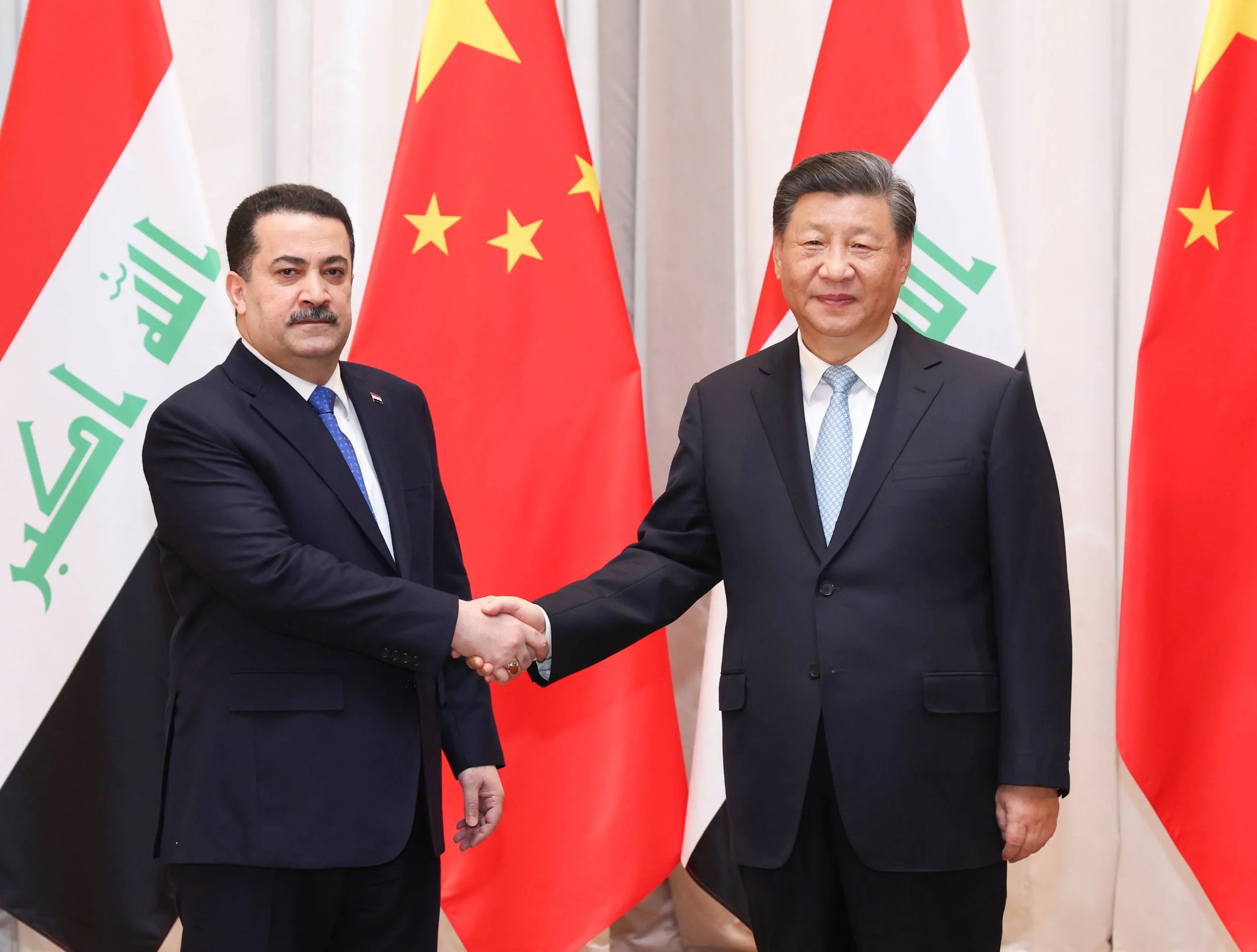
Chinese President Xi Jinping meets with Iraqi Prime Minister Mohammed Shia' al-Sudani in Riyadh. Source: Ministry of Foreign Affairs People’s Republic of China
China in Iraq after the War: From Underdog to Unassailable (London: Bloomsbury Publishing, 2025)
IBSN: 9781350542488
By Shirzad Azad
Under President Xi Jinping, China has considerably expanded its footprint across the Middle East, transforming from a cautious actor into a significant economic, political, and diplomatic stakeholder. It is against this broader shift in China-Middle East relations that Shirzad Azad’s Iraq After the War: From Underdog to Unassailable examines Beijing’s rising role in post-2003 Iraq.
Azad’s central argument is that the 2003 U.S. invasion of Iraq created an opening that enabled Beijing to reposition itself from peripheral observer to indispensable partner in one of the world’s most vital regions. Rather than confronting the United States directly, China capitalized on Iraqi disillusionment with postwar instability by projecting an alternative model of engagement, one that emphasized noninterference and economic partnerships. Iraq, in Azad’s account, became a testing ground for both China’s expanding global economic role and its broader efforts to articulate a post-U.S. international order grounded in development, one in which China works to cultivate an image of a responsible and restrained leader, that is, a “builder” rather than an “invader.” [1]
The book unfolds thematically across seven chapters that trace China’s evolving role from relative marginality to strategic dominance in Iraq. Chapter 1 reconstructs the historical context of Sino-Iraqi relations, beginning with the 1958 coup that toppled the Hashemite monarchy through the 2003 U.S. invasion, underscoring China’s cautious neutrality during the Iran–Iraq War (1980-88) and the Gulf War (1990-91). Yet even during a supposed “neutrality,” China cultivated a habit of quiet engagement through trade, arms sales, and “diplomatic double-dealing,” all while laying the institutional and ideological foundations for later assertiveness. [2] The U.S. invasion marked a decisive turning point, as Beijing was quick to welcome the establishment of the Iraqi Governing Council (the interim government from July 2003 to June 2004), reopen its embassy, and initiate high level exchanges, notably the visit to Beijing by Iraq’s first post-2003 president, Jalal al-Talabani, signaling its willingness to engage with Iraq’s new order. By juxtaposing the image of the American “invader and destroyer” with that of the Chinese “builder and genuine friend,” [3] Beijing sought to craft a narrative that could resonate with some postwar Iraqi elites disillusioned by the evolving relations with the West.
Chapters 2 and 3 explore how this new posture was primarily operationalized, but not exclusively, through, defense and energy relations. In the defense sector, China capitalized on Western export restrictions to Iraq to become the leading supplier of drones, missiles, and fighter jets, notably the JF-17 and CH-series unmanned aircraft, embedding itself deep in Iraq’s security infrastructure. [4] Yet it is energy that forms what Azad calls the “backbone” of China’s success in Iraq. [5] Through state-owned giants such as CNPC and PetroChina, Beijing secured long-term stakes in major oil fields such as Rumaila and Halfaya. By 2022, Chinese firms controlled nearly 60 percent of energy deals in Iraq; at the same time, Beijing became Iraq’s largest crude buyer, importing roughly 45 percent of its oil exports. [6]
Subsequent chapters explore how this material foundation evolved into a broader developmental partnership. Chapter 4 details how the Belt and Road Initiative, China’s global infrastructure and investment strategy, and the 2019 “Oil-for-Construction” framework, under which Iraq supplied 100,000 barrels of crude oil per day in exchange for Chinese-built infrastructure such as schools and airports, epitomizes this new model of transactional development. Chapter 5 expands on this economic entanglement, charting China’s ascent as Iraq’s top trading partner. By 2023, bilateral trade exceeded $53 billion. [7] During the same year, the Central Bank of Iraq began settling transactions with China in Chinese yuan, symbolizing both a deepening economic relationship and a modest move toward de-dollarization. [8] Azad insightfully interprets these dynamics not only as evidence of economic leverage but as elements of China’s strategy to normalize its global role as a development-oriented great power.
If these preceding chapters detail China’s material strategies, Chapter 6 turns to the cultural and discursive dimensions of its ascent, emphasizing how Beijing was able to fuse economic engagement with soft power through debt relief, vaccine diplomacy, and educational programs such as Mandarin instruction. The narrative of “America bombs, China builds” [9] reinforced this perception, amplified by a pro-China lobby of Iraqi politicians and businessmen, mainly those aligned with pro-Iran factions, who promoted deeper engagement with Beijing. This lobby, camouflaged as a grassroots organization called The Popular Movement of the Belt and Road Initiative and the Port of al-Faw, championed China as a counterweight to the West. Yet this narrative was also self-serving: China’s “moral” posturing concealed a deeply strategic pursuit of business opportunities and access to oil. In Azad’s framing, Iraq became not only a laboratory for China’s global image-making but also a microcosm of how moral discourse and material interests intertwine in the making of a new global order. The book concludes with an examination of China’s cautious engagement with the semi-autonomous Kurdistan Region of Iraq (KRI) in northern Iraq. Despite the KRI’s investment potential, Beijing involvement remains limited to economic and cultural contacts. Azad convincingly attributes this restraint to Beijing’s aversion to separatist politics, mindful of its own domestic red lines concerning Xinjiang, Tibet, and Taiwan. [10]
As a work of deep empirical synthesis, China in Iraq after the War succeeds admirably. Azad marshals a vast array of sources to demonstrate that China’s rise in post-2003 Iraq was neither accidental nor purely reactive. Instead, it was the product of a disciplined, multi-sectoral strategy that fused together economic statecraft, image management, and geopolitical patience. Yet the book also raises unresolved questions. In focusing the analysis on contrasting U.S. militarism with Chinese expediency and accepting Chinese official narratives without fully interrogating the underlying motives or internal contradictions, Azad risks overstating the moral distinction between the two. Moreover, such framing inadvertently reproduces a binary in which U.S. actions are cast as overtly coercive while China’s are portrayed as benign, obscuring more nuanced realities that inform both states’ engagement with Iraq.
In fact, the book’s own empirics make clear that Chinese companies operating in Iraq were grounded by a distinct “pragmatism” adapted to Iraq’s deeply corrupt and fragmented political order. Chinese firms thrive because, inter alia, they proved adept at navigating Iraq’s clientelist structures, paying kickbacks, cooperating with militias, and maneuvering through opaque bureaucracies to secure contracts and protection. Moreover, while the book persuasively traces China’s ascent in Iraq, it pays little attention to Iraqi agency. Indeed, one is compelled to say that Iraqi elites have also instrumentalized relations with Beijing to pursue internal rivalries, consolidate patronage networks, and balance ties with Washington. By leaving this important dimension unexplored, the book stops short of offering a fuller understanding of the reciprocal dynamics that shape the growing China-Iraq relationship.
Nevertheless, China in Iraq after the War makes an important contribution to the debates on global order, great-power politics, and postwar reconstruction. It demonstrates how close relationships need not emerge solely through ideology or coercion, but also through infrastructure, investment, and economic development. As only a handful of books concerning China-Iraq relations exist, this publication fills a void by addressing themes that have hitherto been overlooked but are crucial for understanding both this relationship as well as the broader international order. For scholars of political economy, it reveals that China’s expansion relies as much on narrative as on capital. In conclusion, this book is more than an account of Sino-Iraqi relations; it is a reflection on how the 21st century new hegemonies are built: quietly, transactionally, and on the mishaps of another hegemon.
About the author
Yasir Kuoti is a Ph.D. student in political science at Boston University, specializing in international relations and comparative politics, with regional focus on the Middle East, including U.S Middle East policy. He obtained his B.A. from the University of Wisconsin and M.A. from Marquette University, both in international affairs. He can be reached at Ykuoti@bu.edu
Endnotes
[1] Shirzad Azad, China in Iraq after the War: From Underdog to Unassailable (London: Bloomsbury Publishing, 2025), pp. 17.
[2] Ibid., pp. 9, 25-30.
[3] Ibid., pp. 80.
[4] Ibid., pp. 36-38.
[5] Ibid., pp. 40.
[6] Ibid., pp. 55-62.
[7] Ibid., pp. 93.
[8] Ibid., pp. 100.
[9] Ibid., pp. 65.
[10] Ibid., pp. 129.
Disclaimer
The views expressed in this paper are solely those of the author and do not reflect the opinions of the editors or the journal.