How Polarized Multilateralism Hurts Democracy (Volume 21, Issue 1)
Latin America and Caribbean 2025 Summit-hosting season reinforces a trend toward the normalization of autocracies
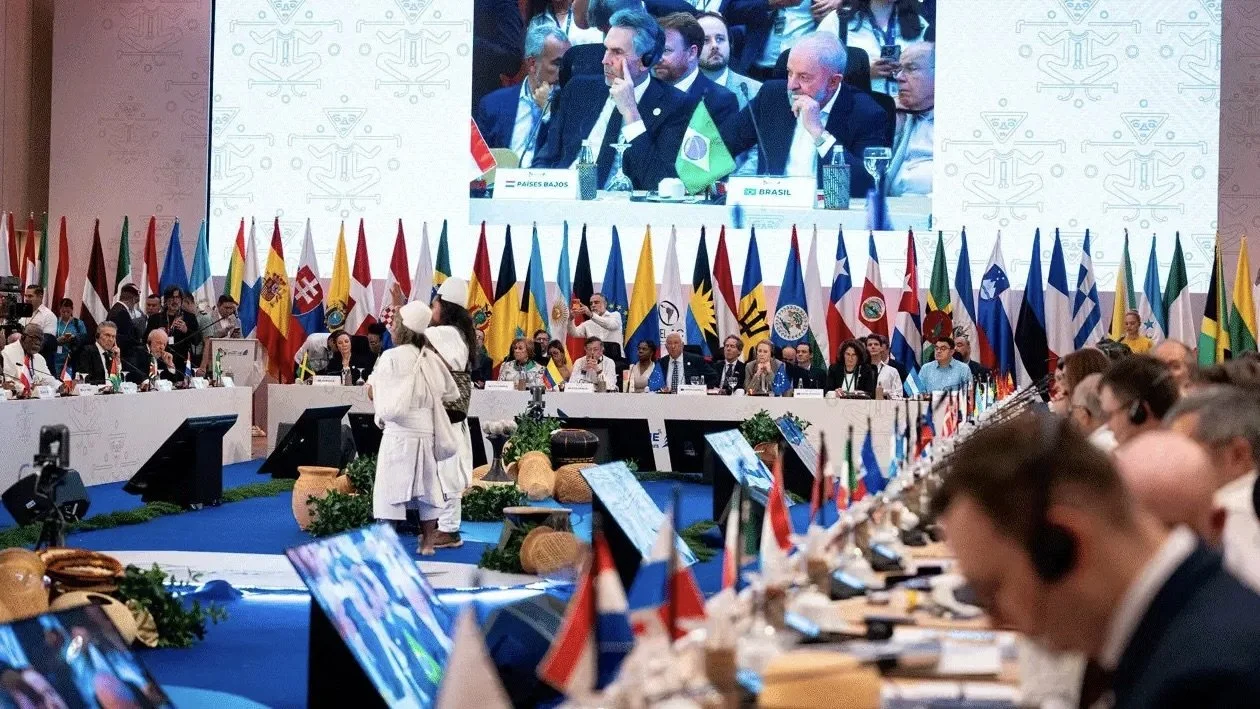
Fourth EU-CELAC summit in Santa Marta, Colombia. Source: Colombia's Ministry of Foreign Affairs
By Marian Vidaurri
Polarization and double standards affect the quality of multilateralism, which hurts democracy. The underlying summit-hosting season dynamics in Latin America and the Caribbean in 2025—including key multilateral meetings such as the BRICS Summit, Community of Latin America and Caribbean States (CELAC)-European Union Summit, United Nations Climate Change Conference (COP30), and the Summit of the Americas—calls into question the effectiveness of multilateralism and its role (or lack thereof) in strengthening regional democratic governance. The tendency towards indifference, tolerance, and normalization of autocracies during high-level diplomatic gatherings reflects the dominant stance of Latin American leadership on democracy defense globally. It also shows the extent to which multilateral meetings produce more noise than tangible results for citizens.
Era of Polarization: Democracies versus Autocracies
The era of existential crisis of multilateralism and democracy has at least two main characteristics: first, democracies are failing to meet citizens’ daily needs and expectations; and second, authoritarian populists are on the rise, helping to expand autocratic regimes. In this context, pernicious and affective polarization molding modern multilateralism does not correspond to a left-right divide, it rather mirrors the clash of values between democracies and autocracies in international affairs. [1] Autocracies are seemingly unchallenged as they consolidate their grip on power and face little to no costs for violating international law, which is symbolic of the ongoing paradigm shift away from a rules-based international order. Whether through the unprovoked invasion of other nations (Russia), engagement in actions that constitute crimes against humanity (Venezuela), or seizing foreign islands and building new ones to expand Exclusive Economic Zones (People’s Republic of China), autocracies thrive in a loose rules-based international order. [2] The Economist Intelligence Unit’s (EIU) Democracy Index Report notes that 39.2% of the world’s population lives under authoritarian regimes and only 6.6% live in full democracies. [3] The failure of representative democracy—stemming from internal and external factors such as entrenched corruption and the skillful ability of outsider populists to capitalize on social and political grievances—to address people’s daily and urgent needs is undermining citizens’ trust in and satisfaction with democracy.
This situation has led to a paradox in which citizens in democracies elect populists who adopt authoritarian practices once in power. An additional paradox is that successful populist candidates that campaign against elites and traditional political establishment embody the new generation of authoritarian elites soon after assuming power. For example, Mexico’s official party, Morena, and its leadership have replaced the PRI-rule one-party system of the 20th-century, except for a strong emphasis on institution building. In El Salvador, Bukeligarchs, new elites supporting President Nayib Bukele, have replaced the dominance of the old elite establishment of the familias and the two-party system that resulted from the 1992 Peace Accords. [4] In Nicaragua, the Ortega dynasty is this century’s variation of the Somoza dynasty, an authoritarian regime that Ortega himself helped depose through revolution in 1979. In Venezuela, Boligarchs, a Venezuelan term for oligarchs, have replaced the economic and political elites derived from the Punto Fijo system. And in Cuba, the only dictatorship that survived lasted through the 20th century in the Americas; the current autocracy replaced the dictatorship it ousted through revolution in 1959.
Given this setting, the trend in the last decade has been the persistent backsliding of democracy and normalization of autocrats despite the proliferation of multilateral spaces in the region that, in theory, promote democracy, human rights, security, and development. Established methodologies that measure quality of democracy, such as Freedom House's Freedom in the World and the EIU’s Democracy Index, indicate a steady decline in the quality of democracy in Latin America and the Caribbean. According to Freedom House, for the thirty-three countries analyzed in the region, in 2015 there were twenty-two countries considered 'Free,' only one country ‘Not Free,’ and ten ‘Partly Free.’ [5] The 2025 report indicated that there were fewer 'Free' and 'Partly Free' countries (twenty and nine, respectively), and the number of ‘Not Free’ quadrupled from one to four. Furthermore, out of the twenty-four countries in the region studied by the EIU from 2015 to 2025, the number of authoritarian regimes doubled from two to four and the number of hybrid regimes increased from six to seven. [6] These indicators show that a primary regional divide between democracies and autocracies increasingly drives polarization, rather than the traditional left-versus-right cleavage. And such polarization impacts the practice and effectiveness of multilateralism.
As Polarization Guides Multilateralism, Global Democracy Suffers
The practice of multilateralism grounded on pernicious polarization harms democratic development. In addition to standard bureaucratic defects and internal politics of international institutions, the principle of neutrality takes precedence when States respond to evidence of undemocratic practices and human rights abuses. For instance, out of the sixteen declarations and resolutions that the member states of the Organization of American States (OAS) adopted during its general assembly held in June 2025, only one addressed an urgent political and institutional crisis thanks to the leadership of Antigua and Barbuda: the dire situation in Haiti. [7] The participating delegations, with one exception, ignored dictatorships in Venezuela, Cuba, and Nicaragua, undermining the organization’s political relevance and neglecting norms that define its raison d'être, especially the Inter-American Democratic Charter. [8] The Americas is home to three of the ten largest democracies in the world (the United States, Brazil, and Mexico); yet only one of this group, the United States, through the intervention of Deputy Secretary of State Christopher Landau, mentioned the Nicolás Maduro regime’s stolen 2024 election and its intensifying repression of the opposition. [9] Brazil and Mexico—which are in theory democratic juggernauts from the Global South—remained silent. Member States dedicated space and time to celebrate Spanish language week and the question of the Falkland Islands but failed to recognize or condemn crimes against humanity in Venezuela, the consolidation of the Ortega family authoritarian regime, and the Cuban regime’s continued repression and intimidation of dissidents at home and abroad. Multilateralism, when practiced in this manner—where States ignore the obvious presence of autocrats—fails to advance the democratic cause. Instead, it normalizes democratic erosion and cohabitation with authoritarians. [10]
Many Meetings, Big Agendas, and Avoidance of the 21st Century Authoritarians
Multilateralism’s normalization of authoritarianism, with its underlying polarization and double standards, extends beyond the OAS. While the ideals of inclusion and diversity are essential in diplomacy, the proliferation of multilateral blocs in the Global South raises the question: what do these new forms of multilateralism seek to achieve. New diplomatic clubs do not prioritize democratic strengthening and resilience as their primary goals. These groups, lacking formal administrative structures, foundational charters, and binding international norms, aim to create new political spaces to challenge Western and Global North governance models. Brazil hosted the BRICS 17th Summit on July 6-7, 2025, and in the resulting Rio de Janeiro Declaration, "Strengthening Global South Cooperation for a More Inclusive and Sustainable Governance," the word ‘democracy’ is mentioned only three times. [11] However, these mentions refer to democracy as an aspiration for a more democratic international governance system, not as a goal within its members' domestic governance systems. Initially a five-country bloc (Brazil, Russia, India, China, and South Africa) the group now includes Egypt, the United Arab Emirates, Indonesia, Ethiopia, and Iran. As membership expands and the type of regimes participating diversifies, the prospect of collaboration and consensus dilutes. Expansion costs became visible during the preparatory meeting on April 29, when participating foreign ministers failed to agree on a joint communique. [12] President Luiz Inácio Lula da Silva, a longstanding ally of Bolivarian leadership, and a former union leader who fought against a 20th century military dictatorship in Brazil, has stopped short of naming the Maduro regime a dictatorship. [13] The recent Brazilian government’s shift in its approach to the Maduro regime is driven less by a moral commitment to democratic values and more by domestic political demands along with external geopolitical and economic pressures. [14] Out of the current ten BRICS full members, only four are democracies according to the EIU’s Democracy Index. According to this index, Brazil, India, Indonesia, and South Africa are ‘flawed democracies’ while the rest are authoritarian regimes. [15]
In the second half of 2025, Latin America hosted three key international meetings. Colombia hosted the fourth CELAC-European Union Summit in November, Brazil hosted the COP30 in November, and the Dominican Republic was scheduled to host the Summit of the Americas in December. CELAC is as another example of Global South response to traditional multilateral organizations; it emerged as an alternative to the OAS that allows for the Cuban regime to participate in hemispheric multilateralism without holding it accountable to democratic principles and human rights standards, while excluding the region’s two industrialized nations (Canada and the United States). The Colombian government sought to position itself as a leader on the global stage, in compensation for the instability exhibited by the Gustavo Petro Administration since its inception and its shortcomings in defending democracy during regional crises. President Petro not only responded timidly to the Venezuelan election crisis in 2024 and the Maduro regime’s repression of opposition, but publicly called for giving general amnesty to regime members currently under investigation by the International Criminal Court for crimes against humanity. [16] At a Summit meant to strengthen transatlantic cooperation between regions composed mostly of democracies, the presence of the Cuban regime and its sympathizers at the CELAC-EU Summit weighed heavily on the meeting’s tone and outcomes. The main source of discussion was the increased military presence of the United States in the Caribbean. As expected, the meeting’s final declaration failed to mention democratic backsliding and the human rights abuses in current authoritarian regimes such as the Maduro regime in Venezuela and the Ortega regime in Nicaragua. [17]
The Maduro regime’s links to Cartel of the Suns and other transnational organized crime groups—that has provoked an increased U.S. military presence in the Caribbean—resulted in the postponement, but de facto cancellation, of the Summit of the Americas due to be held in the Dominican Republic. This cancellation was in part because the Dominican Republic had to navigate a difficult balance between defending democracy, upholding the principle of inclusion in regional multilateralism, and maintaining its strong partnership with the United States. If the host country favors inclusion, inviting authoritarian governments, it risks undermining its perceived support for democratic principles. It also risks losing the participation of the United States. In the previous Summit of the Americas, held in Los Angeles, the Biden Administration did not invite authoritarian governments. [18] The cancellation of the 2025 Summit of the Americas precisely at a moment when regional multilateral dialogue is most crucial highlights the shortcomings of multilateralism.
Multilateralism Reform: Possible and Unlikely
Multilateralism per se is not the problem; rather, it is the practice of multilateralism that requires reform. The international community needs more multilateralism, not less, but it also needs diplomacy that is not grounded on toxic polarization, double standards, or tu quoque. A recent example of the self-serving nature of multilateral meetings was the “Democracy Always” summit, which Chile hosted with the fellow leftist governments of Brazil, Spain, Colombia, and Uruguay. Even though the current Chilean government remains a unique and exemplary case of coherent democracy defense in foreign policy, the resulting collective declaration from the meeting did not mention the Cuban, Nicaraguan, or Venezuelan authoritarian regimes. [19]
Multilateralism’s reform is possible and necessary. Old approaches to diplomacy are no longer effective for new global challenges, including the rise of authoritarian populism and declining trust in democracy. However, there are ways to rethink multilateralism to help, not hinder, democracy. First, permit an active role for international civil society at high-level summits. While there are generally processes in place to include organized civil society, their participation is broadly cosmetic, limited, and carefully curated, hindering their ability to hold diplomats accountable. Second, create oversight and watchdog organizations, such as UN Watch, that specialize in holding international organizations and diplomatic clubs accountable. Third, involve big tech in high-level political conversations in a more institutionalized manner. Multilaterals should give big tech permanent non-voting observer seats to better address authoritarians' use of big tech’s tools to intimidate opponents and deepen misinformation and also to address the impact of technology and artificial intelligence in modern society.
And fourth, reform from within. Democratic world leaders have a responsibility to fashion a new paradigm of foreign policy, away from political calculations and closer to a values system based on rule of law, individual rights, and freedoms. This mindset change requires leadership and humility, which are often overtaken by inertia, events, and never-ending crises. However, small steps and creative thinking is a good start. Multilaterals should replace old-fashioned official statements that avoid mentioning the main challenge, such as the dictatorships in Latin America, with an interactive roundtable debate with key stakeholders such as civil society, international organizations, watchdogs, big tech, and diplomats. Instead of delivering self-serving political agreements and empty declarations, multilaterals should create actionable deliverables targeted toward a wide audience. Citizens crave authenticity and connection, and thus to restore faith in diplomacy, multilateralism, and democracy, leaders can start setting the example. In sum, high-level diplomacy must become more sensitive and attuned with the needs and suffering of the victims of modern authoritarianism, and less on reacting to authoritarian attacks, addressing self-serving interests, or indulging in summit hallway chatter.
As Latin America and the Caribbean hosted, and postponed, major summits in 2025, international attention intensified, prompting renewed questions about the merits and limits of multilateralism. If the Hemispheric community continues to normalize autocracies, it will signify the failure of regional multilateralism to denounce human rights violations and attacks on democracy. Multilateralism practiced this way—anchored in polarization, ignoring 21st century autocrats from all sides of the political spectrum, and at times supporting them—hurts democracy and the prospects for democratic renewal.
About the authors
Marian Vidaurri is a Research Associate at the Cornell Brooks Center on Global Democracy. She is an alumna of Cornell (BA), University of Oxford (MSc), University of Pennsylvania (MPA), and SAIS Johns Hopkins University (Doctor of International Affairs). Her book, “Venezuelan Negotiations: From Deadlock to Collapse (2014-2024),” published by Springer (forthcoming January 2026), discusses why negotiations failed to resolve the Venezuelan crisis between 2014 and 2024.
Endnotes
[1] Rachel Beatty Riedl et al., “Democratic Backsliding, Resilience, and Resistance,” World Politics 77, no. 1, suppl. (2025): 151–77.
[2] John B. Bellinger III, “How Russia’s Invasion of Ukraine Violates International Law,” Council on Foreign Relations, accessed October 17, 2025, https://www.cfr.org/article/how-russias-invasion-ukraine-violates-international-law;
“Venezuela: Harsh Repression and Crimes against Humanity Ongoing Fact-Finding Mission Says,” Office of the United Nations High Commissioner for Human Rights (OHCHR), accessed October 17, 2025, https://www.ohchr.org/en/press-releases/2025/03/venezuela-harsh-repression-and-crimes-against-humanity-ongoing-fact-finding;
Gregory B. Poling, “How to Slay a Giant: Reviving the South China Sea Arbitration, ” Center for Strategic and International Studies (CSIS), January 10, 2025, accessed October 1, 2025, https://www.csis.org/analysis/how-slay-giant-reviving-south-china-sea-arbitration.
[3] The Economist Intelligence Unit, “Democracy Index 2024,” accessed October 17, 2025, https://www.eiu.com/n/campaigns/democracy-index-2024/.
[4] “Bukele deja de ser burgués y se convierte en oligarca,” Diario Co Latino, September 23, 2024, accessed November 16, 2025, https://www.diariocolatino.com/bukele-deja-de-ser-burgues-y-se-convierte-en-oligarca/.
[5] Freedom House, “Freedom in the World 2025,” accessed October 17, 2025, https://freedomhouse.org/sites/default/files/2025-02/FITW_World_2025_Feb.2025.pdf.
[6] The Economist Intelligence Unit, “The Democracy Index,” accessed October 17, 2025, https://www.eiu.com/n/global-themes/democracy-index/.
[7] Organization of American States (OAS), “Democracy for Peace, Security, and Development,” AG/doc.5903/25, August 1, 2009, p. 15, accessed November 16, 2025;
Caribbean News Global, “The Continuing Distress of the Haitian People,” June 19, 2025, accessed November 16, 2025, https://caribbeannewsglobal.com/the-continuing-distress-of-the-haitian-people/.
[8] Organization of American States, Inter-American Democratic Charter, adopted September 11, 2001, Lima, Peru, accessed October 17, 2025. https://www.oas.org/en/democratic-charter/.
[9] United States Department of State, “Deputy Secretary of State Christopher Landau at the Organization of American States General Assembly,” June 2025, accessed October 17, 2025, https://www.state.gov/releases/office-of-the-spokesperson/2025/06/deputy-secretary-of-state-christopher-landau-at-the-organization-of-american-states-general-assembly;
“Center Finds Democracy Thwarted in Venezuela,” The Carter Center, accessed October 17, 2025, https://www.cartercenter.org/news/features/p/democracy/center-finds-democracy-thwarted-in-venezuela.html;
“Unprecedented Venezuela Repression Plunging Nation into Acute Human Rights Crisis, UN Fact-Finding Mission Says,” OHCHR, accessed October 17, 2025, https://www.ohchr.org/en/press-releases/2024/09/unprecedented-venezuela-repression-plunging-nation-acute-human-rights-crisis.
[10] Rubén M. Perina, “La OEA, en la encrucijada,” Clarín, July 20, 2025, accessed November 16, 2025, https://www.clarin.com/opinion/oea-encrucijada_0_B4EQulGXlJ.html.
[11] Maiva D’Auria, “BRICS Summit Signs Historic Commitment in Rio for More Inclusive and Sustainable Governance,” BRICS, July 6, 2025, accessed November 16, 2025, https://brics.br/en/news/brics-summit-signs-historic-commitment-in-rio-for-more-inclusive-and-sustainable-governance.
[12] Lisandra Paraguassu, “Growing BRICS Group Shows Internal Rifts as Ministers Fall Short of Joint Statement” Reuters, April 29, 2025, accessed November 16, 2025, https://www.reuters.com/world/brics-ministers-fail-reach-joint-statement-brazil-warns-against-protectionism-2025-04-29/.
[13] Lisandra Paraguassu, “Venezuelan government has authoritarian bias, says Brazil’s Lula,” Reuters, August 16, 2024, accessed November 16, 2025, https://www.reuters.com/world/americas/venezuelan-government-has-authoritarian-bias-says-brazils-lula-2024-08-16/.
[14] Felipe Krause and Gabriel Brasil, “Lula Is Finally Turning on Venezuela,” Foreign Policy, October 8, 2024, accessed November 16, 2025, https://foreignpolicy.com/2024/10/08/lula-is-finally-turning-on-venezuela/.
[15] The Economist Intelligence Unit, “Democracy Index 2024,” accessed October 17, 2025, https://www.eiu.com/n/campaigns/democracy-index-2024/.
[16] Gustavo Petro [@petrogustavo], “Levantamiento todas las sanciones contra Venezuela. Amnistía general nacional e internacional. Garantías totales a la acción política. Gobierno de cohabitación transitorio. Nuevas elecciones libres…,” X (formerly Twitter), August 15, 2024, accessed November 16, 2025, https://x.com/petrogustavo/status/1824118561050169566.
[17] “Joint declaration of the CELAC-EU summit 2025,” European Council, November 9, 2025, accessed November 16, 2025, https://www.consilium.europa.eu/media/o1wefgqk/joint_statement_celac_20251113.pdf.
[18] “Who’s Invited? Selecting Attendees at the Summit for Democracy,” The Fletcher Forum of World Affairs, February 24, 2021, accessed November 16, 2025, https://www.fletcherforum.org/home/2021/2/24/whos-invited-selecting-attendees-at-the-summit-for-democracy.
[19] Gobierno de Chile, “Declaración Reunión de Alto Nivel,” accessed October 17, 2025, http://prensa.presidencia.cl/comunicado.aspx?id=301564.
Disclaimer
The views expressed in this paper are solely those of the author and do not reflect the opinions of the editors or the journal.