When Women Withdraw: The Global Politics of Refusal Feminist resistance, digital diffusion, and the transnational life of 4B (Volume 21, Issue 1)
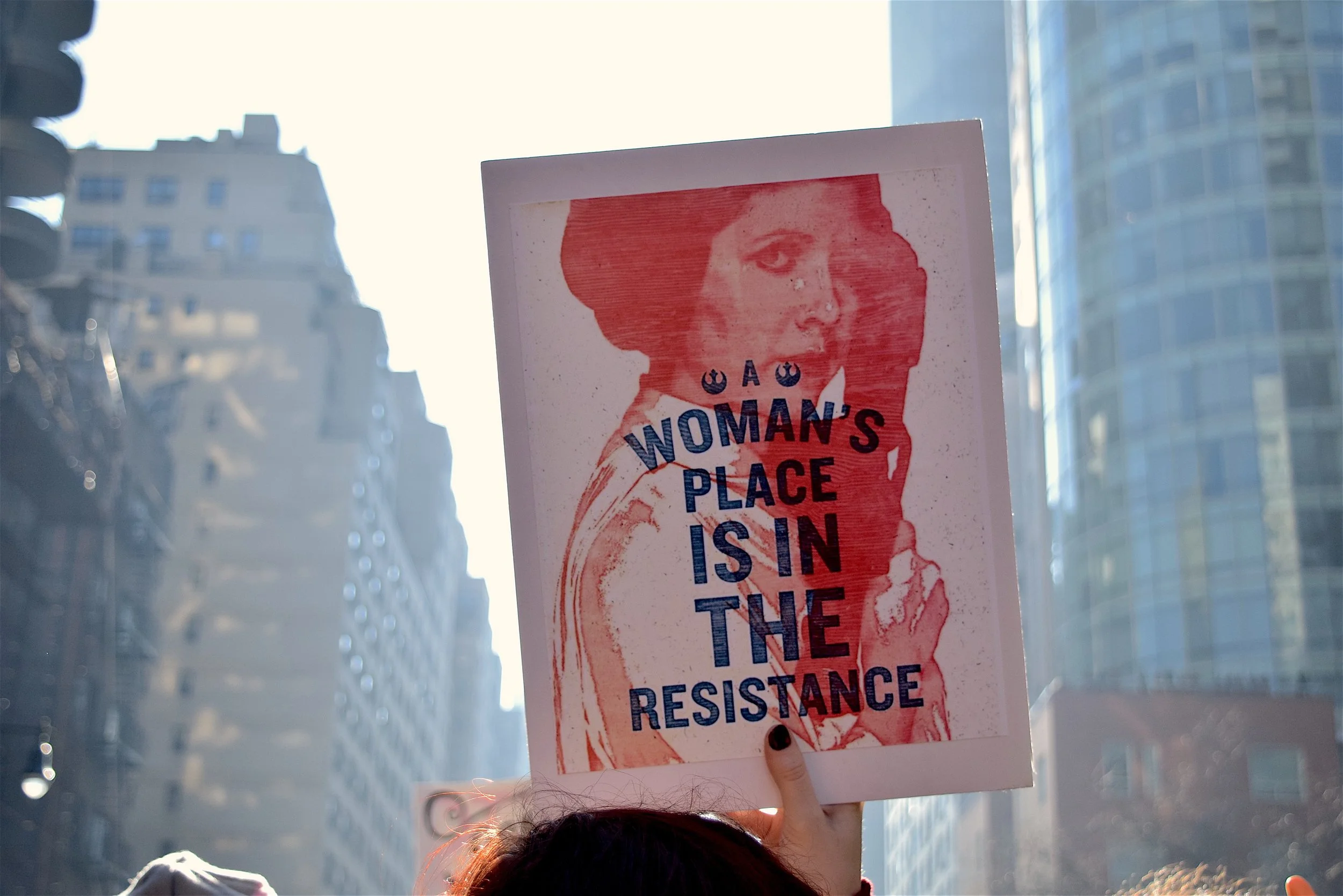
Women International Day protest. Source: Public Domain
By Ankita Singh Gujjar
Introduction
In Seoul's subway stations, shiny billboards praise cosmetic surgery and bridal expos, but increasing numbers of young women are burning their cosmetics and renouncing marriage. [1] This juxtaposition encapsulates 4B (the "Four Nos"), a feminist movement calling on South Korean women to say no to marriage, motherhood, dating, and sex with men. This essay asks: How does the 4B Movement challenge both neoliberal and patriarchal structures simultaneously, and why do its politics of refusal resonate so powerfully across borders? Using feminist IR and postcolonial theory, it situates 4B amid today’s global anti-gender backlash. It argues that women's individual refusals are a type of transnational political resistance against both state power and transnational capitalist hierarchies. The paper first explores how 4B emerged from South Korea’s gendered political economy, then situates its radical politics of refusal within feminist international relations (IR) and postcolonial theory, and finally examines how its message travelled to the United States, revealing new pathways for global feminist resistance and governance.
The Rise of the 4B Movement
The 4B movement emerged in the late 2010s as young South Korean women rebelled against a patriarchal society shaped by neoliberal labour market reforms, export-led growth, and state policies that prioritised productivity over welfare. South Korea’s gender order, shaped by Cold War development and export capitalism, shows how domestic hierarchies uphold and reproduce the global economic systems they are embedded in. Although South Korea is a modernised nation, it upholds archaic gender norms. South Korea has maintained the OECD’s largest gender pay gap for nearly thirty years, and women’s labour remains undervalued, with many leaving the workforce after marriage or childbirth. [2]
A shocking incident exposed the extent of women’s precarity: in 2016, a young woman was killed outside Gangnam Station by a man who said he targeted her “because women had ignored him,” triggering widespread protests against misogynistic violence. [3] This tragic event symbolised the spectrum of gendered violence that soon extended beyond streets into digital spaces. Online sex crimes, from spy-cams to deepfakes, fuelled outrage at a culture making women constant targets. [4] These moments of insecurity, exploitation, and surveillance reflect both local misogyny and the digital and affective economies of global capitalism that produce gendered precarity.
Such circumstances mobilized a tide of mid-2010s online feminist activism. On platforms such as Megalia and WOMAD, women proclaimed a shared rebellion: what if they refused the roles demanded by society? [5] By 2017, this vision had manifested as 4B (the "Four No's"): no romance, no sex, no marriage, no childbearing, which was less a lifestyle than a rejection of patriarchal capitalism. [6] Korean women adopted a labour-strike attitude toward gender relations: just as exploited workers withhold their labour, women would withhold their bodies and emotions from men. [7]
The early expansion of the movement coincided with the “Escape the Corset” campaign, where teenage girls destroyed makeup kits and cut their hair short to protest restrictive beauty standards. In a nation with the world's tenth-largest beauty market, such behaviour pierced both national patriarchy and international beauty capitalism. [8] Marxist-feminist criticism hung in the air: 4B followers denounced capitalism's selling-out of women, encouraging less spending on "self-fashioning labour" and instead, saving for financial independence. [9] Yet this self-help culture also mirrors the logics of neoliberal individualism even as it protests them, revealing how feminist resistance can be both enabled and constrained by the capitalist systems it seeks to reject. [10] Women try to fight the system while still being stuck inside it, which makes their resistance both powerful and limited at the same time. Protesting marriage and motherhood then becomes an economic and political protest against a system that drains women through unpaid care labour, which includes everyday domestic and emotional work such as cooking, cleaning, childcare, and caring for family members, even as the same system normalizes women as “incomplete” in the absence of husbands.
4B's emergence cannot be disentangled from South Korea's demographic concerns and state policies. With the lowest fertility rate in the world (0.72 in 2023), the state introduced pronatalist initiatives encouraging premature marriage and childbearing. [11] Many young women felt that the "pronatalist state" stripped them of their humanity and made them into "birth-machines." They resented President Moon Jae-in’s and later President Yoon Suk-yeol’s ‘baby bonus’ incentives, which ignored workplace sexism and the double burden of working mothers. [12] Similar demographic anxieties are visible across East Asia. For instance, Japan’s own pronatalist campaigns likewise frame women’s reproductive labour as a patriotic duty, reflecting how neoliberal states transform fertility into a matter of economic productivity rather than personal autonomy.
The 4B movement was a conscious protest against such a climate. As gender studies scholars Lee and Jeong argue, it "embraces not just critiques of the pronatalist turn in state policy…but also offers women one possible vision of a feminist future…that does not involve being part of the state's reproductive future.” [13] In short, 4B adherents refuse to “solve” the fertility crisis on the state’s terms; their refusal to participate is itself a declaration. This is also postcolonial feminist in its resistance: South Korean women resist not only domestic patriarchy, but also a global capitalist hegemony that pushes them to perform idealised femininity, from motherhood to K-beauty, for nation and market. By opting out in droves, they reveal how deeply these internal and external arrangements are intertwined. [14] In international relations (IR), such collective withdrawal functions as a form of soft disobedience, a nonstate politics that exposes the limits of state power and redefines participation itself as a site of resistance.
Theoretical Anchors: From the Personal to the International
Feminist researchers demonstrate that personal lives cannot be separated from international politics. Cynthia Enloe's statement that "the personal is international" holds true in the case of 4B. The movement began with young women questioning how intimate decisions, dating, marriage, and childbearing were shaped by forces beyond personal choice. In Enloe's words, notions of what it is to be a "respectable" woman are constructions of colonial policies, international markets, and military ideologies. [15] The employment market of Korea, the beauty trade, and fertility campaigns are constructions of global capitalist and Cold War gender regimes. Postwar U.S. development aid tied women’s labour to export manufacturing, military occupation zones fostered beauty and service industries catering to Western ideals, and later state-led fertility policies mirrored global anxieties about population control and productivity. In the terms of IR, 4B discloses how international political and economic arrangements materialize in the daily lives of women, rendering intimate choices arenas of geopolitical resistance.
Most importantly, 4B frames resistance as a political act, a notion explained by Audra Simpson and Kathi Weeks. Simpson posits that "refusal can be a powerful alternative to recognition" by ruling powers. [16] Rather than seeking approval, 4B women reject patriarchal norms, adopting a stance of noncooperation that asserts autonomy. Using a Marxist-feminist perspective, Weeks interprets the “refusal of work” or of gendered labour such as wifehood and motherhood as a utopian vision of life beyond capitalism. [17] The 4B strike, like a workers’ strike, imagines life free from exploitation.
From a peace-studies perspective, Johan Galtung’s theory of structural violence highlights the unseen harms that 4B resists. South Korean women experience direct violence, harassment and abuse, but also structural violence in expectations to marry, leave work, and accept wage disparity. [18] These deep-seated pressures "impair fundamental needs" and limit life opportunities. In Galtung’s violence triangle, structural violence operates alongside direct violence and cultural violence, the latter referring to the norms and beliefs that justify gender hierarchies and make such harm appear natural. This interlocking system of direct, structural, and cultural violence aligns with human security frameworks, where security is not just the absence of conflict, but also freedom from fear and freedom from want—that is, freedom from economic precarity, deprivation, and barriers to basic well-being. [19] Feminist scholarship has long identified gendered violence and economic insecurity as central to these insecurities and has challenged traditional notions of peace and protection. In politicizing everyday harm, 4B echoes feminist critiques of peacekeeping and human security that point to the private sphere as a legitimate site of international politics. [20]
All this happens in the context of a worldwide anti-gender backlash. Everywhere, right-wing movements bemoan "gender ideology" as an assault on social order. South Korea is no exception: as feminist activism grew, animosity from young men and conservatives intensified. President Yoon came to office denying gender discrimination and promising to eliminate the Ministry for Gender Equality. [21] This backlash has parallels elsewhere: the attacks on "gender ideology" by Hungary and Poland and the rollback of reproductive rights in the United States under Trump, for example, use anti-gender politics to reassert patriarchal authority through conservative or authoritarian political actors. Within such an environment, 4B's denial becomes both a domestic protest and transnational act of resistance, laying bare how even individual dissent resonates through global gender politics.
Transnational Diffusion: From South Korea to the United States
Although limited in its domestic reach, the message of the 4B movement expanded globally. In late 2024, as the United States faced its own political earthquake through the re-election of Donald Trump and the overturning of Roe v. Wade, American women began invoking 4B as a form of protest. A viral tweet urging U.S. women to “embrace the Korean 4B movement” gained 17 million views in a day, TikTok videos featuring #4B surged, and Google searches of 4B rose by 450 percent. [22] Most viewed the movement as a radical survival plan in the face of regression. Trump's administration and the repeal of reproductive rights represented a misogynistic shift in American politics. [23] By "boycotting men"—not having sex, not dating, and not marrying—women withdrew consent from a system dismantling their rights. This act of collective disengagement mirrors the form of noncooperation theorised by Audra Simpson and Kathi Weeks: a deliberate withdrawal of labour, intimacy, and recognition that transforms personal refusal into political resistance. If the state could strip them of bodily autonomy through abortion bans, women could withhold access to their bodies as a powerful counter-gesture. [24]
The U.S. version of 4B reconfigured the movement's agenda. In South Korea, it stood against state-mandated roles and gendered insecurity; in the United States, it resisted a right-wing backlash undermining reproductive rights. American activists referred to it as the "Four No's" movement or invoked Lysistrata, a Greek comedy in which women organise a sex strike to pressure men into ending a war, as a symbolic ancestor of feminist noncooperation. [25] This cultural translation illustrates what transnational feminist scholars describe as vernacularization, the adaptation of global ideas to local contexts. [26] Although its form changed, from refusing marriage to refusing bodily control, the same logic of individual refusal as political protest remained.
The rapid diffusion reflects the inner workings of digital transnational advocacy networks, which mobilise ideas through information exchange. [27] Korean feminists had already defined 4B in terms that easily circulated across social media. International coverage amplified it as a "women's strike." Quite significantly, this impact moved east-to-west: feminist concepts, traditionally sold from the West to Asia, now reversed direction. [28] This reverse diffusion announces a new global feminism enabled by digital connectedness. Activists use Keck and Sikkink's "boomerang pattern" to link across state borders, creating external pressure when local channels are closed. [29] American women, though not acting against Korea’s state, lent publicity and symbolic legitimacy to Korean activists, whose message gained new resonance in global feminist discourse. While this transnational attention may not have yielded direct material gains, it significantly expanded 4B’s symbolic capital, transforming a local boycott into a globally recognized language of feminist refusal."
Shared patriarchal patterns made 4B legible abroad South Korea's pronatalist pressures, pay gaps, and gendered violence reflected U.S. inequalities: a ruling party accused of sexual misconduct, the erosion of #MeToo victories, and ongoing care burdens. [30] In both contexts, women perceived that traditional modes of advocacy had failed. In South Korea, women confronted a political blockade; in the United States, women faced legal regression. So 4B seemed like a last protest measure: when systems refuse reform, withdrawal itself becomes resistance. A Chinese feminist in London captured this transnational appeal: “It is dangerous to openly challenge the government. I was impressed that Korean women found a way to do it on a personal level… to challenge the state’s instrumentalization of women as reproductive machines.” [31] Whether confronting authoritarianism or conservative politics, refusal becomes a portable grammar of resistance.
Yet this transplantation is imperfect. Some Korean feminists worry that Western adopters skip over 4B's indigenous roots and Korean women's structural discrimination. [32] By contrast, American writing tends to elide homophobia and transphobia, showing how solidarity can be lost in translation. [33] Transnational feminism must find a middle ground of shared principles and contextual sensitivity. Nevertheless, the fact that a marginal Korean Twitter movement entered U.S. discourse during the Trump presidency highlights how international digital politics facilitate new channels of feminist resistance and norm circulation.
Implications for Feminist Policy and Global Governance
4B’s transnational movement exposes the gap between global promises of gender equality and women’s lived realities, as they remain excluded from formal policymaking. Institutions such as the UN and OECD have adopted gender-mainstreaming approaches, yet these remain technocratic and focused on representation rather than structural transformation. Movements like 4B reveal how this institutional feminism fails to capture everyday economic and affective exploitation despite progressive laws and gender metrics. A similar disillusionment is evident in Latin America’s Ni Una Menos movement, which likewise indicts state-led gender agendas for failing to confront structural violence and economic precarity. [34] 4B thus stands as counter-discourse to liberal “empowerment” narratives that reduce women to development agents rather than political actors seeking systemic change.
This gap shapes global governance itself. The international order continues to privilege the state, sidelining grassroots politics that defy state interests. In contrast, 4B functions as an alternative international politics, rooted in refusal rather than participation. Its digital networks embody informal multilateralism: a cross-border flow of feminist norms independent of states or NGOs. A comparable dynamic is seen in Iranian Feminist Twitter activism during the #WomanLifeFreedom movement, where diasporic and domestic networks sustained visibility despite censorship and repression. [35] Recognizing such informal pathways is vital to rethinking how gender norms are made and contested.
Further, 4B’s east-to-west diffusion unsettles Western dominance over defining feminist agendas. A Korean movement shaping U.S. debates reverses epistemic hierarchies and signals a decolonisation of feminist knowledge, marking a shift toward multipolar feminist politics. For policy, this calls for intersectional global governance. Such governance could institutionalize lessons from 4B and other non-Western feminist movements through transnational coalitions, feminist data frameworks, and South-South cooperation mechanisms that centre localized experiences in global policymaking. States and institutions must treat digital feminist movements not as fringe disruptions but as diagnostics of systemic disparity, protecting online feminist spaces through stronger anti-harassment laws, data rights, and recognition of gendered cyberviolence. Feminist policymaking must move beyond token inclusion toward redistributive frameworks addressing care economies, workplace exploitation, and reproductive autonomy.
Finally, 4B illustrates that women's withdrawal from patriarchal systems is itself geopolitical: when large numbers reject marriage or reproduction, they disturb the demographic and economic logics through which states build legitimacy. Feminist refusal thus becomes a kind of nonstate power, demonstrating that international relations are structured not only by diplomacy or coercion, but also by the quiet, cumulative politics of noncooperation. In this sense, 4B's politics of withdrawal epitomizes a broader shift in global resistance, where withdrawing consent becomes a transnational instrument of power that redefines agency.
About the author
Ankita Singh Gujjar is a Commonwealth Shared Scholar at the University of Nottingham pursuing an MA in International Security and Terrorism, where she researches feminist international relations, international political economy and digital resistance in East Asia.
Endnotes
[1] Sophie Jeong, “Escape the Corset: How South Koreans Are Pushing Back Against Beauty Standards,” CNN Style, January 11, 2019, https://edition.cnn.com/style/article/south-korea-escape-the-corset-intl.
[2] Jihye Jeong, “Boycotting Men? How the 4B Feminist Rebellion Is Taking on Patriarchy,” Atlantic Fellows for Social and Economic Equity Blog, March 19, 2025, https://afsee.atlanticfellows.lse.ac.uk/en-gb/blogs/how-the-4b-feminist-rebellion-is-taking-on-patriarchy.
[3] Sarah Shamim, “What Is the 4B Feminist Movement from S Korea That's Taking Off in the US?,” Al Jazeera, November 9, 2024, https://www.aljazeera.com/news/2024/11/9/what-is-the-4b-feminist-movement-from-s-korea-thats-taking-off-in-the-us.
[4] Harmeet Kaur, “After Trump’s Win, Some Women Are Considering the 4B Movement,” CNN, November 13, 2024, https://edition.cnn.com/2024/11/09/us/4b-movement-trump-south-korea-wellness-cec.
[5] Jieun Lee and Euisol Jeong, “The 4B Movement: Envisioning a Feminist Future With/In a Non-Reproductive Future in Korea,” Journal of Gender Studies 30, no. 5 (2021): 637.
[6] Ibid.
[7] Nicole Dular, “The 4B Movement Is a Labor Strike,” Blog of the American Philosophical Association, September 18, 2024, https://blog.apaonline.org/2024/09/18/the-4b-movement-is-a-labor-strike/.
[8] Jeong, “Escape the Corset.”
[9] Kathi Weeks, The Problem with Work: Feminism, Marxism, Anti-Work Politics and Postwork Imaginaries (Durham: Duke University Press, 2011), 109–10.
[10] S. Bridges, Neoliberal Lives: Gender, Precarity, and Work (London: Routledge, 2017), 55–56.
[11] Statistics Korea, Birth Statistics in 2023 (Seoul: Statistics Korea, 2023), https://kostat.go.kr/board.es?mid=a20108100000&bid=11773&act=view&list_no=433208.
[12] Yyvette Tan and Suhnwook Lee, “South Korea Elections: They Helped Oust a President. Now Women Say They Are Invisible Again,” BBC News, June 1, 2025, https://www.bbc.co.uk/news/articles/cy8njzr42zvo.
[13] Lee and Jeong, “The 4B Movement,” 639.
[14] Françoise Vergès, A Decolonial Feminism, trans. Ashley J. Bohrer (London: Pluto Press, 2021), 336.
[15] Cynthia Enloe, Bananas, Beaches and Bases: Making Feminist Sense of International Politics, 2nd ed. (Berkeley: University of California Press, 2014), 197–200.
[16] Audra Simpson, Mohawk Interruptus (Durham: Duke University Press, 2014), 22.
[17] Weeks, The Problem with Work, 109–10.
[18] Johan Galtung, “Violence, Peace, and Peace Research,” Journal of Peace Research 6, no. 3 (1969): 171.
[19] UNDP, Human Development Report 1994: New Dimensions of Human Security (New York: Oxford University Press, 1994).
[20] J. Ann Tickner, Gendering World Politics (New York: Columbia University Press, 2001).
[21] Jean Mackenzie, “As South Korea Abolishes Its Gender Ministry, Women Fight Back,” BBC News, December 14, 2022, https://www.bbc.co.uk/news/world-asia-63905490.
[22] Alaina Demopoulos, “‘No Man Will Touch Me Until I Have My Rights Back’: Why Is the 4B Movement Going Viral after Trump’s Win?,” The Guardian, November 8, 2024, https://www.theguardian.com/us-news/2024/nov/07/4b-movement-trump-women.
[23] Carter Sherman, “Trump Launches Fresh Attacks on U.S. Abortion Rights,” The Guardian, March 5, 2025, https://www.theguardian.com/us-news/2025/mar/04/trump-attacks-abortion-rights-idaho-south-carolina.
[24] Shamim, “What Is the 4B Feminist Movement?”
[25] Harvey Day, “The History of Sex Strikes,” BBC Three, May 16, 2019, https://www.bbc.co.uk/bbcthree/article/1fc04f3e-3128-4be7-a78a-28ea31db4101.
[26] Sally Engle Merry, Human Rights and Gender Violence: Translating International Law into Local Justice (Chicago: University of Chicago Press, 2006), 219.
[27] Margaret E. Keck and Kathryn Sikkink, Activists Beyond Borders: Advocacy Networks in International Politics (Ithaca: Cornell University Press, 1998), 49.
[28] Raphael Rashid, “As 4B Takes the World by Storm, South Korea Is Grappling with a Backlash Against Feminism,” The Guardian, November 15, 2024, https://www.theguardian.com/world/2024/nov/15/4b-south-korea-feminist-movement-donald-trump-election-backlash.
[29] Keck and Sikkink, Activists Beyond Borders, 25.
[30] The Guardian, “Sexual Misconduct Allegations against Donald Trump: A Timeline,” October 25, 2024, https://www.theguardian.com/us-news/2024/oct/25/trump-sexual-misconduct-allegations-timeline.
[31] Jeong, “Boycotting Men?”
[32] Maria Yagoda, “4B Is Not the Winning Strategy to Resist the Patriarchy People Think It Is,” TIME, November 20, 2024, https://time.com/7177557/4b-us-women-resisting-patriarchy-essay/.
[33] Merry, Human Rights and Gender Violence, 135.
[34] Jaclyn Diaz, “How #NiUnaMenos Grew From the Streets of Argentina Into a Regional Women’s Movement,” NPR, October 15, 2021, https://www.npr.org/2021/10/15/1043908435/how-niunamenos-grew-from-the-streets-of-argentina-into-a-regional-womens-movemen.
[35] Anwar Mhajne, Leah Tabor, and Brian Traves, “Online Responses and Backlash to ‘Women, Life, Freedom’ Hashtag Activism,” Global Studies Quarterly 5 (2025), https://doi.org/10.1093/isagsq/ksaf063.
Disclaimer
The views expressed in this paper are solely those of the author and do not reflect the opinions of the editors or the journal.