The Synapse Collapse Exposes Why the World Needs Stronger Fintech Regulation (Volume 21, Issue 1)
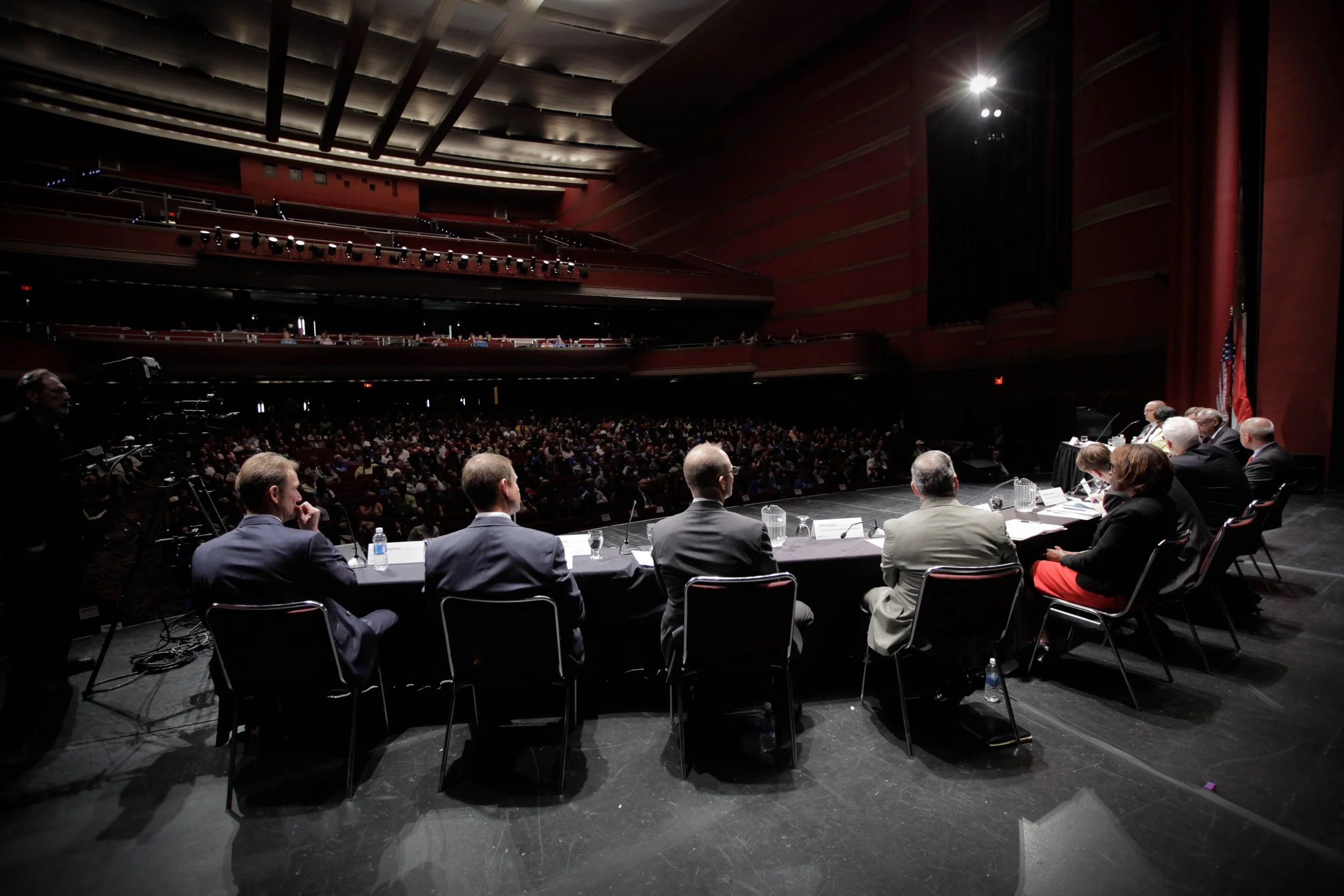
Consumer Financial Protection Bureau field hearing. Source: Public Domain
By Rafael Morales-Guzman
When Synapse Financial Technologies, Inc. collapsed in April 2024, more than 100,000 people lost access to over $265 million held across several fintech platforms. By May, partner banks were unable to retrieve accurate customer balance records, making it extremely difficult to process withdrawals. Many months later, a significant number of users still cannot access their funds.
Synapse was a technology and ledger service provider, a bridge connecting fintech apps with Federal Deposit Insurance Corporation (FDIC)-insured banks. It did not take deposits directly. Instead, it reconciled and routed pooled customer funds into omnibus accounts, known as “For Benefit Of” (FBO), at partner institutions, sitting strictly in the middle of the money flow. Synapse Financial Tech was the parent company of two subsidiaries, Synapse Brokerage LLC (a registered broker-dealer) and Synapse Credit LLC (a state-licensed lender). Through them it also offered cash management and credit origination infrastructure, but the core business was facilitating and tracking banking-related customer funds. Synapse generated income through a fee-based model, charging fintech partners and banks for compliance, payments routing, ledger management, and platform connectivity. Legally, most of its operations fell under broker, tech, and agent regimes, not direct depository or investment fund regulation. This places the policy debate of its collapse squarely in the realm of operational supervision, third-party risk, and oversight of critical financial infrastructure.
This was not just another failed tech company, it was a wake-up call about the gap between what fintech companies promise and the regulations designed to protect users. The Synapse crisis demonstrated how the “banking-as-a-service” (BaaS) model has created structural risks that current regulations can’t keep up with. [1]
At its core, the problem is that technology “middleware providers” are bridge companies that sit between nonbank financial firms and licensed banks. [2] They have become significant players of the system operating largely outside traditional regulatory oversight and play an increasingly central role in facilitating the flow of funds in the U.S. financial system. Unlike regulated banks, these technology firms aren’t subject to regulatory standards that traditional financial institutions must follow. As financial institutions keep outsourcing relevant functions to third-party providers, such as loan processing, cybersecurity, customer onboarding, and mobile banking, these middleware platforms have become deeply integrated into the financial system infrastructure. As the Financial Stability Board notes, the scale and complexity of interactions with an ecosystem of third-party providers have grown significantly in recent years, increasing systemic exposure and oversight challenges. [3]
The solution requires strong, minimum rules for technological platforms that connect users, fintechs, and banks. These rules should be set by multinational organizations, similar to how the Basel Committee on Banking Supervision coordinates standards for international banking. These standards should include operational capital buffers, resilience stress tests, and crisis plans. They must cover these systemically important digital intermediaries, closing regulatory gaps and making sure everyone plays by the same rules, no matter their business model or home country. Like the Basel framework, this approach would establish a global floor for resilience requirements, while allowing national regulators to implement and enforce these standards in ways that better suit their own legal and supervisory contexts.
What Synapse Promised and How It Failed
Founded in 2014 and lauded as a unicorn by venture investors including Andreessen Horowitz, Synapse built a BaaS platform that helped to bring fintechs startups alive and scale bold new financial services. For example, Synapse powered fintechs such as Yotta, a prize-linked savings app, and Juno, which offers integrated crypto with checking and payment services.
Synapse did so by offering startups the ability to issue debit and credit cards, join card networks, open accounts, process payments, and streamline compliance. Synapse provided the relationships to FDIC-insured banks like Evolve Bank & Trust and technology to replicate core banking infrastructure, without a bank license. [4] The core promise was transformative: using Synapse’s platform, a fintech could offer products traditionally limited to banks, such as high-yield savings accounts, offer instant payments, issue no-fee branded debit cards, or offer early direct deposits, all without building bank infrastructure from scratch. For consumers, this meant sleek mobile apps, faster access to funds, and financial tools often unavailable at brick-and-mortar banks. However, the collapse of Synapse exposed how unstable these assurances truly were. The system’s foundation depended on Synapse’s proprietary technology for the reconciliation of pooled banking accounts, known as “For Benefit Of” (FBO), where most of customer funds were channeled. When customers deposited funds, they did so through fintech apps, which were connected to Synapse’s software. Synapse routed these funds into FBO accounts held at partner banks (such as Evolve Bank & Trust, AMG National Trust, American Bank, and Lineage Bank) but maintained the sub-ledger tracking individual customer balances itself. Unlike brokered deposit arrangements where banks maintain direct customer records, this arrangement introduced a three-party structure: the regulated bank held pooled funds, Synapse managed the customer-level accounting, and the fintech app served as the entry point for users. Critically, neither the bank nor the fintech provider had direct access to the granular sub-account data. As a result, the system’s integrity rested solely on Synapse’s technology and controls, which proved to be the Achilles heel of this model.
Synapse’s collapse was triggered by a series of disputes with key partner banks and major fintech clients, operational breakdowns, and a mismatch between internal ledgers and bank-held funds. As core clients and banks terminated their partnerships, Synapse’s infrastructure rapidly unraveled, exposing unreconciled pooled accounts. Key events included Evolve Bank demanding a $50 million reserve and withholding payments; Mercury, one of the largest Synapse’s fintech clients, abruptly pulled deposits and ended its contract; and the failure to reconcile end-user funds, which left tens of thousands stranded without access. A failed acquisition by TabaPay, internal disputes over liability, and a lack of contingency planning further deepened the crisis. With no viable rescue in sight and ongoing legal and regulatory pressures, Synapse filed for Chapter 11 bankruptcy in April 2024, highlighting how fragile these platform-based financial ecosystems can be when fundamental relationships and recordkeeping fail. [5]
Painfully, customers of services like Yotta Savings or Juno genuinely believed their funds held the same protections as those at any conventional bank, an idea consistently reinforced by marketing and communications that highlighted deposit insurance protection from the customer-face fintechs apps. [6] As documented by Alessandra De Zubeldia, affected users expressed misleading messages about deposit insurance coverage. One user recounted, “I emailed [Yotta], made sure it was FDIC-insured. Of course, they emailed me back and told me, ‘Yes, it’s FDIC-insured,’ which we now know is not true.” [7]
Unlike the straightforward relationship between banks and their customers, Synapse’s approach established complex, multitiered structures linking nearly 100 fintech applications to a patchwork of FDIC-insured banks, facilitating billions in annual transactions. [8] When Synapse entered bankruptcy, its ledgers proved so compromised that basic questions of asset ownership became unanswerable. Disparities between Synapse's records and those of its partner banks exposed significant vulnerabilities in multiparty reconciliation and accountability, trapping funds and subjecting tens of thousands of users to prolonged financial uncertainty. Although Synapse Financial Technologies filed for Chapter 11, its FINRA and SIPC-member subsidiary, Synapse Brokerage, was not part of the process. Before the filing, Synapse transferred funds into Synapse Brokerage accounts. The two entities shared employees, functions, and systems, adding legal and operational complexity. As bankruptcy trustee, former FDIC Chair, Jelena McWilliams reported:
“All employees of Synapse Brokerage were terminated prior to my appointment on May 24, 2024, further complicating end-users’ efforts to regain their funds or communicate with Synapse Brokerage. At this time, Synapse Brokerage does not have any remaining employees who could interpret Synapse or Synapse Brokerage ledgers to assist in the reconciliation efforts or respond to end-users’ inquiries.”
She identified shortfalls between $65 million and $95 million against customer claims and urged the Federal Reserve, FDIC, and OCC to provide relief for funds stuck in legal limbo. [9]
Systemic Risks and Regulatory Gaps in Global BaaS Markets
The Synapse crisis highlights significant dangers posed by what I term the “weakest-link problem” in fragmented BaaS ecosystems. This architecture exists when critical services for licensed banking are dispersed across a chain of unregulated fintechs: it only takes one vulnerable point to break the whole system. Middleware platforms typically operate as invisible infrastructure, quietly processing and holding vast customer funds. When these systems function as intended, consumers are rarely aware of the intermediaries involved. However, at the point of failure, the underlying complexity erupts disorderly, leaving customers trapped in bureaucratic limbo. Caught between technology platforms and partner banks, neither party assumes full responsibility.
Crucially, middleware firms remain largely outside the domain of rigorous prudential regulation. They are not subject to maintain operational capital buffers, resilience stress tests, or disclose contingency planning, despite their proven capacity to trigger systemic crises. This regulatory asymmetry forces regulators into a reactive stance: only after collapse do authorities scramble to untangle accountability and safeguard consumers.
Some analysis estimates the global BaaS market will reach $60–75 billion by 2030, expanding at annual rates above 16 percent. While this is negligible compared to the roughly $189 trillion in global banking assets reported by the Financial Stability Board in 2023, its role as the connective infrastructure between fintechs and banks makes it systemically relevant. [10] More importantly, BaaS shows signs of accelerating fastest in emerging markets and the Asia-Pacific, where unmet demand for financial inclusion drives rapid adoption. In Europe, providers like Solaris leverage regulatory “passporting” to deliver services across all European Union (EU) member countries, facilitating large-scale fintech-bank partnerships. African fintechs, facing limited legacy banking infrastructure, increasingly depend on BaaS partnerships to reach underbanked populations. Yet, regulatory fragmentation persists, with inconsistent national regimes limiting harmonization and complicating cross-border compliance. [11]
Interconnection and Concentration Risks
The interconnection risk extends beyond individual failures. Modern tech middleware providers don't just connect fintechs to banks; they are increasingly interconnected with each other. They share banking partners, technology stacks, even key personnel. When the Federal Reserve issued a cease-and-desist order to Evolve Bank & Trust, one of Synapse's key partners, it revealed how even regulated banks often fail to properly oversee these relationships. [12]
The concentration risk is staggering. In many countries, just a handful of middleware firms dominate market access, forming highly interconnected hubs that the Dallas Fed and Financial Stability Board (FSB) warn could threaten systemic stability if disrupted. [13] Unlike traditional systemically important banks, these BaaS aggregators typically operate without operational capital buffers, resilience stress tests, or crisis planning, even as their technical rails underpin millions of customer accounts. Their “too interconnected to fail” role means operational failures or mismanagement could cascade through the wider financial ecosystem, yet regulatory frameworks consistently lag in designating and safeguarding such critical third-party service providers.
Some BaaS platforms operate across national borders, complicating jurisdictional oversight. A single point of failure, whether in the United States, Europe, or Asia, can propagate disruptions internationally, exposing customers in multiple jurisdictions to risk.
Three Fundamental Regulatory Gaps
The Synapse crisis revealed critical regulatory gaps that persist across jurisdictions in three areas:
First, consumer protection frameworks fail to account for intermediary failure risks. In the United States, FDIC insurance protects bank depositors but excludes BaaS intermediary bankruptcies, a distinction many Synapse customers discovered only when attempting to access frozen funds. Synapse and some fintech partners appear to have mismarketed insurance protections, creating further confusion about the safety of customer accounts. In October 2023 before the bankruptcy, Synapse announced it was transferring customer deposits into brokerage accounts at its subsidiary Synapse Brokerage, which would be covered by the Securities Investor Protection Corporation (SIPC) rather than FDIC. However, this posed significant confusion about whether accounts were FDIC- or SIPC-insured. Evidence from social media reveals this confusion. As one post from Reddit r/SynapseVictimsFight noted:
“[A] [d]irect quote I got from Juno is contradictory to what the trustee stated where she confirmed SIPC insurance is not in place! As stated in all brokerage account agreements, customer funds in the Synapse Brokerage Program are deposited in a network of member FDIC banks. Funds held in these banks are eligible for FDIC insurance up to $250,000 for each individual account. Additionally, funds held with Synapse Brokerage also have SIPC insurance up to $500,000, including $250,000 for cash, for each individual account.” [14]
While the FDIC has amended disclosure requirements to clarify this limitation, such protections apply exclusively to insured depository institutions (IDI): fintechs must not misrepresent the scope of deposit insurance. [15] Internationally, deposit insurance schemes vary significantly in coverage, funding, and scope, and typically exclude losses from nonbank intermediary failures.
Second, opacity in multiparty arrangements obscures liability and undermines accountability. Customer funds may be distributed across multiple banks, reconciled through disparate systems, and allocated among parties with distinct operational roles. Academic research and industry analysis on embedded finance highlight substantial regulatory and risk management challenges arising from these multiparty structures, with liability allocation remaining a persistent concern. Academics like Stefano Battiston and colleagues demonstrate that greater complexity in financial networks can reduce a regulator's ability to mitigate risks and amplify the social cost of a crisis, especially when small errors in understanding network relationships lead to outsized errors in assessing default risk. [16]
Third, a fragmented U.S. supervisory landscape with overlapping agency authorities can result in jurisdictional gaps. Synapse operated amid these gaps where no single regulator had comprehensive oversight of its core intermediary functions. The Federal Reserve maintained authority over partner banks like Evolve Bank & Trust but lacked jurisdiction over Synapse's operations, while the Consumer Financial Protection Bureau could only pursue post-hoc enforcement actions rather than ongoing supervisory actions. [17] By contrast, Europe has moved toward a more harmonized regulatory approach. Regulations like the Payment Services Directive (PSD2) and the Digital Operational Resilience Act (DORA) have established accountability for payment service providers and third-party infrastructure, though these frameworks lack global reach. Supervisory complexity intensifies when BaaS platforms operate cross-border. Companies are frequently headquartered in one jurisdiction while serving consumers across dozens of others, complicating legal responsibilities and amplifying vulnerabilities. While Synapse’s collapse primarily impacted U.S. users, its intended expansion into Latin America and thirty other countries with Utoppia, a regional fintech platform, highlights how cross-border operations can complicate oversight. [18]
A Basel Framework for the Fintech Age
Globally, technology-driven middleware firms now operate in a fragmented and ambiguous regulatory landscape. Banks are regulated because they hold customer deposits. Payment systems are regulated because they transfer money. But what about companies that don't technically perform either of these functions, yet are essential for facilitating these transactions?
The Basel Accords provided an international foundation for bank supervision, balancing financial stability with cross-border banking operations. As the financial system evolves, a comparable framework for BaaS providers is urgently required addressing five fundamental areas:
1. Functional Licensing and Proportional Capital Requirements. Any entity acting as a mediator between consumers and banks should be licensed, with capital buffers calibrated to systemic importance. Capital adequacy should scale with deposit volumes, transactional flows, and operational complexity, directly addressing how entities like Synapse attained systemic relevance while maintaining minimal reserves. While Synapse did not hold deposits or risky assets, its role in managing pooled funds and ledger infrastructure created systemic exposure, which underscore why capital standards must alight with functional operational risks.
This shows why capital standards must align with functional risks, and why robust operational supervision is essential even for nondeposit-taking platforms.
2. Operational Resilience Standards. Every BaaS arrangement should require platforms and partner banks to independently maintain customer ledgers, ensuring daily reconciliation and redundant recordkeeping. Partner banks must retain fundamental obligations for knowing and protecting their customers. Middleware providers should maintain real-time, auditable ledgers, accessible to both banks and regulators. EU principles prohibiting the outsourcing of compliance underscore the necessity for accountability throughout the financial value chain.
3. Cross-Border Supervision Mechanisms. Home-country regulators—ideally in the form of a cross-agency council with robust internal information-sharing—must possess supervisory authority over major middleware providers, supported by robust information-sharing agreements that allow host regulators to monitor local operations. The Basel model for bank supervision offers a template for consolidated oversight. Fintech infrastructure demands unified supervisory frameworks, critical data sharing, and proactive risk scenario analysis.
4. Consumer Protection Standards. Clear, standardized disclosures must inform users of the protections applied to their accounts. At account opening, entities should disclose the custodian of their funds, the specifics and scope of deposit insurance, licensing and regulatory oversight details, and compliance procedures. Regulatory frameworks should require “risk labels” (similar to nutritional labels) that summarize deposit insurance type and coverage, joint liability arrangements, the role of any middleware providers, and regulatory oversight levels. Any service advertising “bank-level” security must guarantee equivalent protections with clear disclosure when funds pass through nonbank intermediaries that may create access risks. The FDIC’s proposed “Synapse rule” in October 2024 addresses these risks by requiring banks to maintain accurate recordkeeping of beneficial owners in custodial accounts, without extending deposit insurance coverage to middleware providers. [19]
5. Resolution Frameworks. Effective pre-established protocols should allow rapid recovery of customer funds in the event of BaaS platform failure, eliminating protracted bankruptcy proceedings. Before accepting customer funds, middleware providers should file resolution plans (“living wills”) detailing asset recovery, data portability, backup recordkeeping, and contingency procedures for transferring services. While current regulations limit liquidity support to nonbanks during insolvency, the Synapse episode shows how the absence of resolution funding can extend consumer harm. Even regulated financial institutions face severe liquidity constraints during the resolution process. Exploring alternative liquidity backstops for technologically important intermediaries may be necessary, even if the traditional lender-of-last-resort window remains restricted. These should include pre-funded mechanisms financed through industry levies and backstopped by government guarantees. Such mechanisms must be strictly limited to operational liquidity during the resolution period subject to volume caps. [20]
Conclusion
The collapse of Synapse serves as an urgent reminder for regulatory coordinated action. Regulatory frameworks must evolve to address the scale and intricacy of contemporary financial technology. Allowing critical infrastructure to remain outside authorities’ oversight is a warning that cannot be ignored. The challenges and opportunities lie with international organizations and national regulators to collaborate proactively, establishing clear standards, delineating responsibility, and centering customer protection. Such measures ensure that the advantages of fintech are distributed equitably, empowering both sophisticated users and those less familiar with its attendant risks. International coordination is the cornerstone of resilient infrastructure supporting sustainable financial innovation. The decision now is whether to seize this moment for preventive action, or to risk another crisis as dramatic as Synapse, forcing belated regulatory reform.
About the author
Rafael Morales-Guzman is a Ph.D. candidate in public policy at the Johnson Shoyama Graduate School of Public Policy, University of Saskatchewan, and a former Digital Policy Hub doctoral fellow at the Centre for International Governance Innovation (CIGI). He holds an M.A. in public administration from Cornell University. His research focuses on regulatory policy, financial technology, and digital innovation, and he has professional experience in financial stability with the Central Bank of Mexico.
Endnotes
[1] Nydia Remolina, “The Regulatory Challenges Raised by the Evolution from Open Banking to Banking-as-a-Service,” CLS Blue Sky Blog, September 16, 2025, https://clsbluesky.law.columbia.edu/2025/09/16/the-regulatory-challenges-raised-by-the-evolution-from-open-banking-to-banking-as-a-service/.
[2] Consumer Financial Protection Bureau, “Synapse Financial Technologies, Inc.,” Enforcement Actions, updated August 21, 2025, https://www.consumerfinance.gov/enforcement/actions/synapse-financial-technologies-inc/
[3] Financial Stability Board, Final Report on Enhancing Third-party Risk Management and Oversight, September 29, 2024, https://www.fsb.org/2024/09/final-report-on-enhancing-third-party-risk-management-and-oversight/.
[4] Consumer Financial Protection Bureau, Stipulated Final Judgment and Order: Synapse Financial Technologies, Inc., United States Bankruptcy Court, Central District of California, August 21, 2025, https://files.consumerfinance.gov/f/documents/cfpb_synapse-fin-tech_stipulated-final-judgment-order_2025-08.pdf; Adam Rust, The Synapse Crisis Reveals the Urgent Need for Supervision of BaaS (Consumer Federation of America, June 2024), accessed November 8, 2025, https://consumerfed.org/the-synapse-crisis-reveals-the-urgent-need-for-supervision-of-baas/; Jelena McWilliams, Case No. 2:24-cv-02870 – Main Document, United States District Court, Central District of California, June 20, 2024, accessed November 8, 2025, https://www.cravath.com/a/web/TuPGwDdX7zyWeATdGJCkc/9cXbw9/9890-287-06_20_2024-pacer287-main-document-012731-00001-central-district-of-california.pdf; Leo Schwartz and Allie Garfinkle, “The Spectacular Synapse Collapse: The Ugliest Divorce in Fintech Left $200 Million in Customer Money Frozen—and Shows the Risks of Financial Apps,” Fortune, March 7, 2025, https://fortune.com/2025/03/07/synapse-evolve-mercury-bankruptcy-lawsuits/.
[5] Leo Schwartz and Allie Garfinkle, “This Wunderkind’s First Startup Went Bankrupt, Leaving $200 Million in Customer Assets Frozen,” Fortune, March 10, 2025, https://fortune.com/2025/03/10/synapse-evolve-mercury-yotta-a16z-fintech-collapse-sankaet-pathak; Jason Mikula, “The Synapse-Evolve Disaster, One Year Later,” Fintech Business Weekly (Substack), October 8, 2023, https://fintechbusinessweekly.substack.com/p/the-synapse-evolve-disaster-one-year.
[6] Schwartz and Garfinkle, “The Spectacular Synapse Collapse”; Emily Mason, “Is Your Money Really Safe in an FDIC-Insured Fintech Account?,” Forbes, June 17, 2024, https://www.forbes.com/sites/emilymason/2024/06/17/is-your-money-really-safe-in-an-fdic-insured-fintech-account/.
[7] Alessandra De Zubeldia, “The Human Cost of Synapse’s Collapse: Savings Lost, Lives Upended,” The Reynolds Center for Business Journalism, March 31, 2025, https://businessjournalism.org/2025/03/synapse-collapse/.
[8] David Krause, From Open Banking to Banking-as-a-Service: Regulatory Challenges in the Evolution of Financial Intermediation (SSRN, 2025), https://papers.ssrn.com/sol3/papers.cfm?abstract_id=4909293; Emily Mason, “Synapse Management Ousted as Fintech Customers Remain Frozen Out of Their Accounts,” Forbes, May 24, 2024, https://www.forbes.com/sites/emilymason/2024/05/24/synapse-management-ousted-as-fintech-customers-remain-frozen-out-of-their-accounts/.
[9] Rajashree Chakravarty, “5 Lessons Learned from Synapse’s Collapse,” Banking Dive, October 30, 2024, https://www.bankingdive.com/news/5-lessons-learned-from-synapses-collapse/731543/.
[10] Financial Stability Board, Global Monitoring Report on Non-Bank Financial Intermediation 2024 (Basel: Financial Stability Board, December 16, 2024), https://www.fsb.org/uploads/P161224.pdf.
[11] Mordor Intelligence, “Global Banking-as-a-Service Market,” Mordor Intelligence Reports, accessed October 13, 2025, https://www.mordorintelligence.com/industry-reports/global-banking-as-a-service-market; Gcinisizwe Mdluli, Ivo Jeník, and Peter Zetterli, Banking-as-a-Service: How It Can Catalyze Financial Inclusion, Reading Deck (Washington, D.C.: CGAP, 2022), https://www.cgap.org/research/reading-deck/banking-service-how-it-can-catalyze-financial-inclusion.
[12] Laird Dilorenzo, “How the Collapse of Synapse Has Affected the Fintech Landscape,” Disruption Banking, February 10, 2025, https://www.disruptionbanking.com/2025/02/10/how-the-collapse-of-synapse-has-affected-the-fintech-landscape/.
[13] Gene Amromin et al., Working Paper No. 2524 (Dallas, TX: Federal Reserve Bank of Dallas, 2025), https://www.dallasfed.org/~/media/documents/research/papers/2025/wp2524.pdf; Financial Stability Board, Enhancing Third-Party Risk Management and Oversight: A Toolkit for Financial Institutions and Financial Authorities (Basel: Financial Stability Board, June 2023), https://www.fsb.org/uploads/P220623.pdf.
[14] Reddit, “No SIPC Insurance? Juno Continues to Put Out False Info,” r/SynapseVictimsFight, posted October 2, 2024, https://www.reddit.com/r/SynapseVictimsFight/comments/1damtik/no_sipc_insurance_juno_continues_to_put_out_false/.
[15] Federal Deposit Insurance Corporation, FDIC Official Signs and Advertising Requirements, False Advertising, Misrepresentation of Insured Status, and Misuse of the FDIC’s Name or Logo, Final Rule, December 20, 2023, https://www.fdic.gov/news/financial-institution-letters/2023/fil23065.html.
[16] Oluwabukola Sambakiu, “Understanding the Rise of Embedded Finance and Banking-as-a-Service Models as Drivers of Structural Transformation in the Financial Services Industry and Their Effect on Market Competition,” GSC Advanced Research and Reviews 24, no. 1 (2025), https://doi.org/10.30574/gscarr.2025.24.1.0198; Chad Gerhardstein, Jay Chakraborty, and Eugénie Krijnsen, “Managing Embedded Finance Risks,” PwC, May 2023, https://www.pwc.com/gx/en/industries/financial-services/publications/managing-embedded-finance-risks.html; Stefano Battiston, Guido Caldarelli, Robert M. May, Tarik Roukny, and Joseph E. Stiglitz, “The Price of Complexity in Financial Networks,” Proceedings of the National Academy of Sciences 113, no. 36 (2016): 10031–36, https://doi.org/10.1073/pnas.1521573113.
[17] Adam Rust, The Synapse Crisis Reveals the Urgent Need for Supervision of BaaS (Consumer Federation of America, June 2024), accessed November 8, 2025, https://consumerfed.org/the-synapse-crisis-reveals-the-urgent-need-for-supervision-of-baas/.
[18] Business Wire, “Synapse and Utoppia Announce Global Partnership to Provide Access to U.S. Dollar Accounts & Services Starting in Latin America,” October 21, 2022, https://www.businesswire.com/news/home/20221021005337/en/Synapse-and-Utoppia-Announce-Global-Partnership-to-Provide-Access-to-U.S.-Dollar-Accounts-Services-Starting-in-Latin-America.
[19] Federal Deposit Insurance Corporation (FDIC), “Notice of Proposed Rulemaking on Custodial Deposit Accounts,” September 16, 2024, https://www.fdic.gov/news/press-releases/2024/pr24075.html.
[20] Sebastian Grund, “Liquidity in Resolution – A Transatlantic Perspective,” Georgetown Washington University Business & Finance Law Review 4, no. 2 (2021): 1–64,https://heinonline.org/HOL/P?h=hein.journals/busfnclr4&i=117.
Disclaimer
The views expressed in this paper are solely those of the author and do not reflect the opinions of the editors or the journal.